
Notre-Dame de la Garde
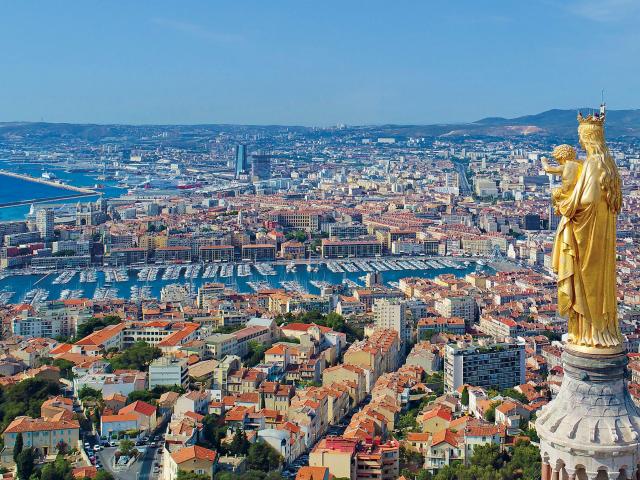
At 154 metres above the city, the gilded Madonna on top of Notre-Dame de la Garde looks not toward her child but out to sea — watching for sailors, the way Marseille has always watched. The basilica is visible from almost anywhere in the city, a fixed point that locals call La Bonne Mère, and that orientation is part of the point: you come up here to see where you are.
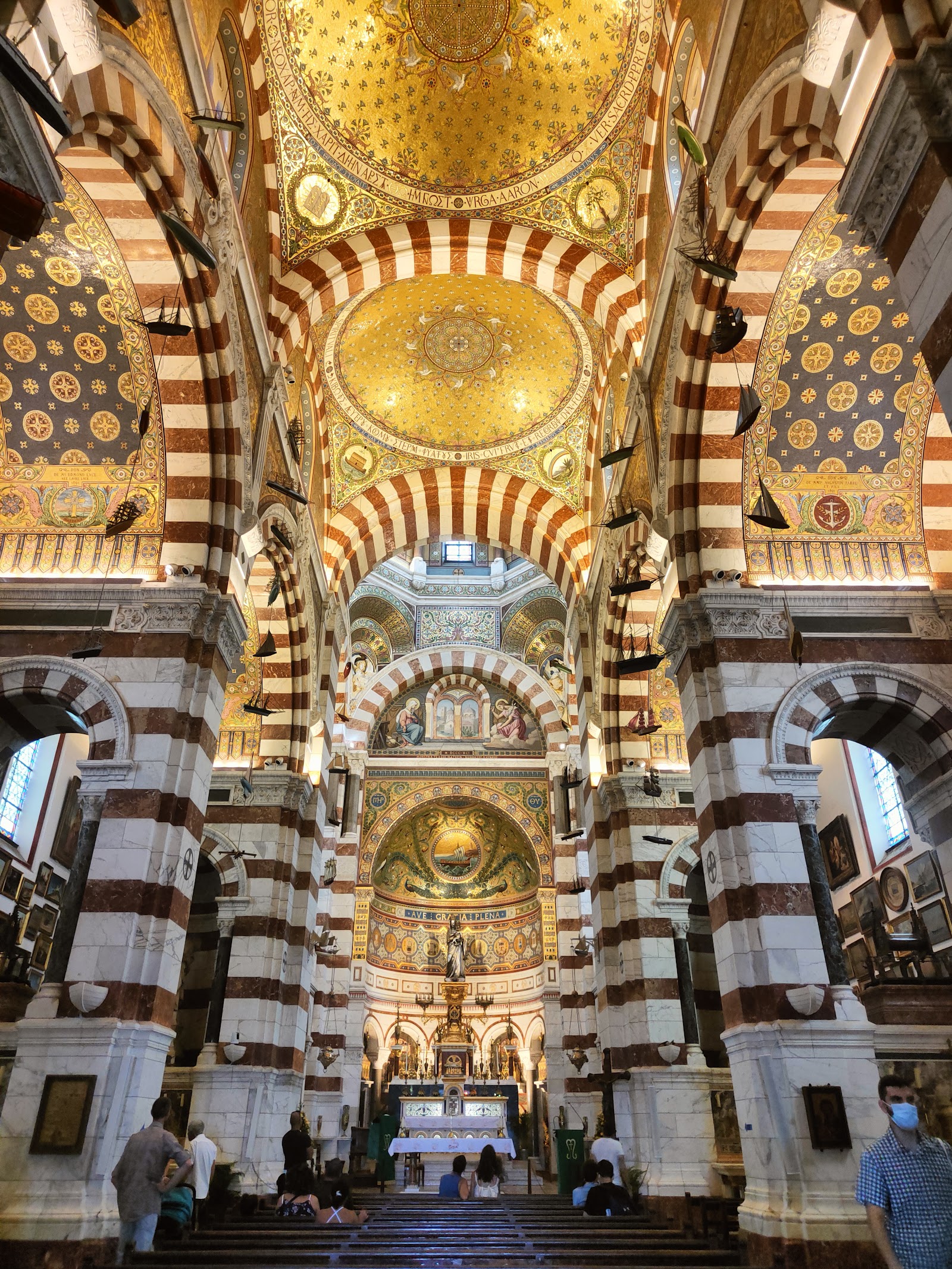
Inside, model ships hang from the ceiling alongside painted plaques left by people who survived storms, wars, and accidents. The ex-voto collection is unlike anything else in the city — a raw, accumulating record of gratitude that has nothing to do with tourism.
💛 What travellers fall for
People who return tend to come at different hours: early morning before the tour groups, or late afternoon when the Mediterranean light turns the Frioul archipelago to gold. The lower Romanesque crypt, carved from rock, gets overlooked — worth the few extra minutes. Wind at the top is not a figure of speech; a hand on your hat is practical advice.
The story behind Notre-Dame de la Garde
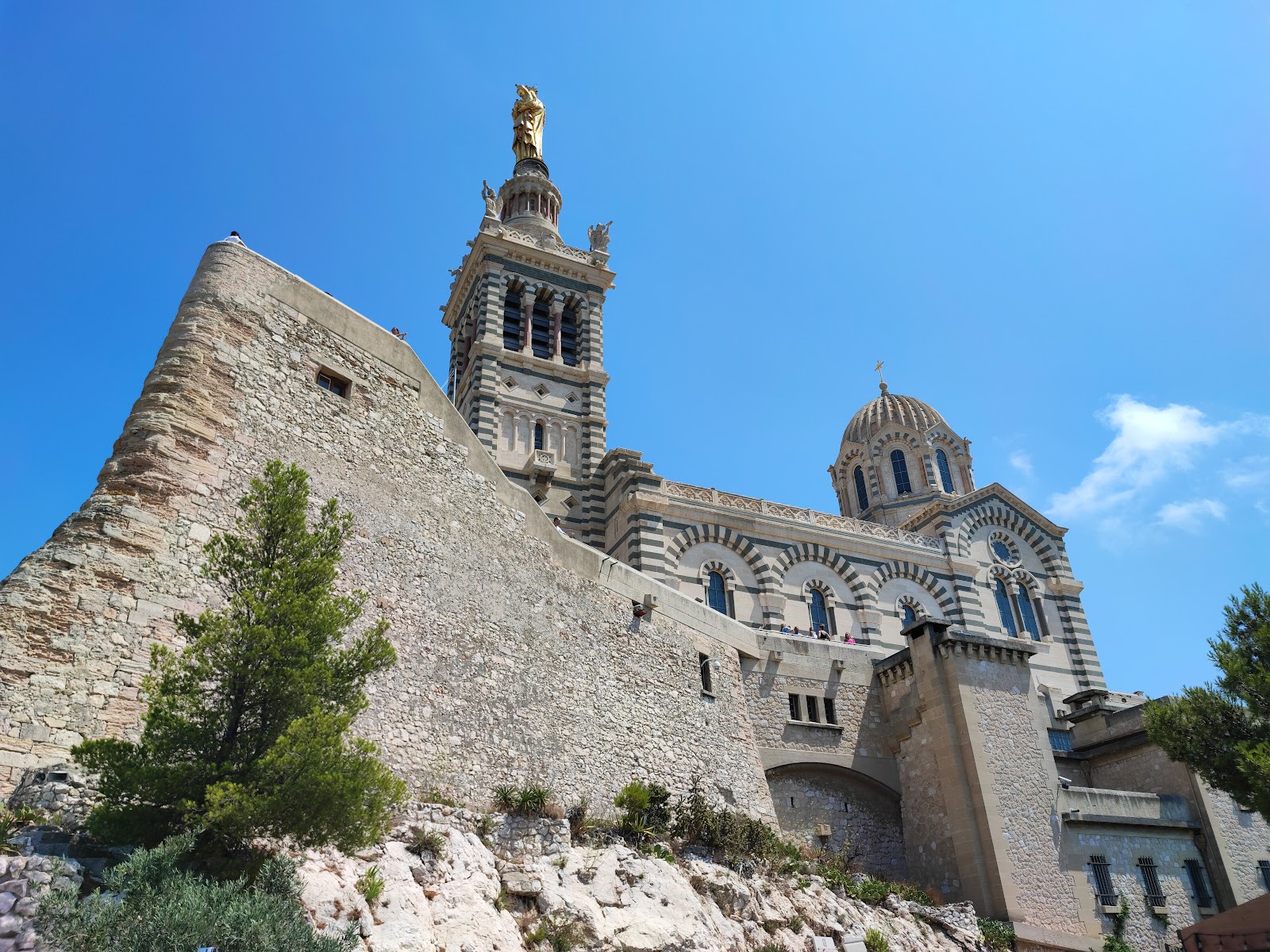
A priest named maître Pierre built the first chapel on this hill in 1214; Pope Honorius III confirmed it in a papal bull four years later. After Pierre's death in 1256 it became a priory, and by the early 15th century a larger building had replaced the original. The present basilica sits on the foundations of a 16th-century fort that Francis I ordered built to resist a 1536 siege by Emperor Charles V.
The first stone of the current structure was laid on September 11, 1853, at the request of the chaplain Father Bernard and to designs by architect Henri-Jacques Espérandieu. The basilica was consecrated, still unfinished, in 1864. The 11.2-metre bronze Madonna — gilded with gold leaf by the Christofle workshops, after sketches by three Parisian artists — was installed in September 1870. A restoration running from 2001 to 2008 addressed mosaics blackened by candle smoke, stonework pitted by pollution, and bullet damage from the Liberation of France.
Good to know
Bus 60 runs directly from the Vieux-Port and drops you at the foot of the stairs. Free entry to the basilica and crypt; dress code applies (shoulders and knees covered). Open daily from 7 AM, until 8 PM in summer. Avoid driving in July and August — the car park fills fast.
May through September brings the clearest skies and the most dramatic evening light, though the terrace is fully exposed and wind can be fierce in any season — the Mistral in spring occasionally scours the air clean enough to see all the way to the Calanques. Winter mornings are quieter and often crisp; dress for it.
Where is Notre-Dame de la Garde?
More tickets & tours for Notre-Dame de la Garde
Book directly at the provider
What travellers say about Notre-Dame de la Garde
A hill on the south side of the Vieux-Port, where the basilica also called la Bonne Mère stands. One of the most visited places in Marseille with a breathtaking view of the entire city. You can get here in various ways, you can easily do it on foot. The interior of the basilica is beautifully decorated with mosaics that have been recently renovated. The number of people depends of course on the season and time. It is probably obvious that it is best to arrive as early as possible in the morning to avoid the crowds. It is definitely worth a visit. If you collect zero euro banknotes, there is a machine where you can buy yours here. At the back, at the other end of the promenade, is a modest monument - Monument des disparus en mer. It is a small, inconspicuous stele, on which is placed a large Camargue cross, which seems to point to the sky while looking at the sea. It bears the names of those who never returned from their voyage across the Mediterranean and whose bodies, jealously guarded by the water, were never found. Pope Francis also stopped here in 2023 during his visit to Marseille.
Great and big church on the hilly side of Marseille... There you can come by foot and you need great condition, by bus no 60,hop of bus or city tourist train... The church is nice and amazing inside... The entrance is free... It's open until 6pm...sometimes it very crowded and better to come early in the morning or after 5pm...The view from here is something really beautiful, you can see all Marseille and around... Also there is shop for souvenirs... All recommendations for visit and take some nice pictures and videos if you are in Marseille
A breathtaking must-see that offers the most spectacular 360-degree views of Marseille and the Mediterranean. Whether you hike up or take the tourist train, the reward at the top is unparalleled. The basilica itself is stunning, with intricate golden mosaics and a peaceful atmosphere that feels worlds away from the bustling port below. It is a beautiful blend of architectural history and spiritual significance. The "Good Mother" watching over the city is a powerful symbol, and the detail in the ex-votos—small boats and paintings left by sailors—is incredibly moving. Pro Tip: Try to visit just before sunset. Watching the sky change colors over the Frioul Islands from this vantage point is a memory you won't soon forget. Free entry, though the climb is steep!
Just great! Beautiful church with a fantastic 360 panorama. A bit of a treck from town as it is on a sharp hill, but ok if you are fit! This time i decided to take the little train which was quite enjoyable too!
Really cool view of the city report about 4 blocks down and it was completely straight up a hill. Then, you get to the location and have to walk up another 3000 stairs. It is straight up, but the views are beautiful. We got there 5 minutes after 6 PM and it closed right at 6. So we were not able to get all the way in and they are very militant about getting you out of this property with French police sitting in cars. Waiting for people to not obey authority. There was lots of patrol officers out there, and I would say, get there before 6 PM or you will be forced out. Immediately, nice place, though.
More of Marseille
Discover where to stay, what to do and the best deals for your trip.
Explore Marseille →More attractions in Marseille
All of Marseille →
Background adapted from Wikipedia (CC BY-SA) · map data © OpenStreetMap contributors · ratings & place photos via Google · other photos with per-image credit. Ticket links may earn us a commission at no extra cost to you.