
Montreuil
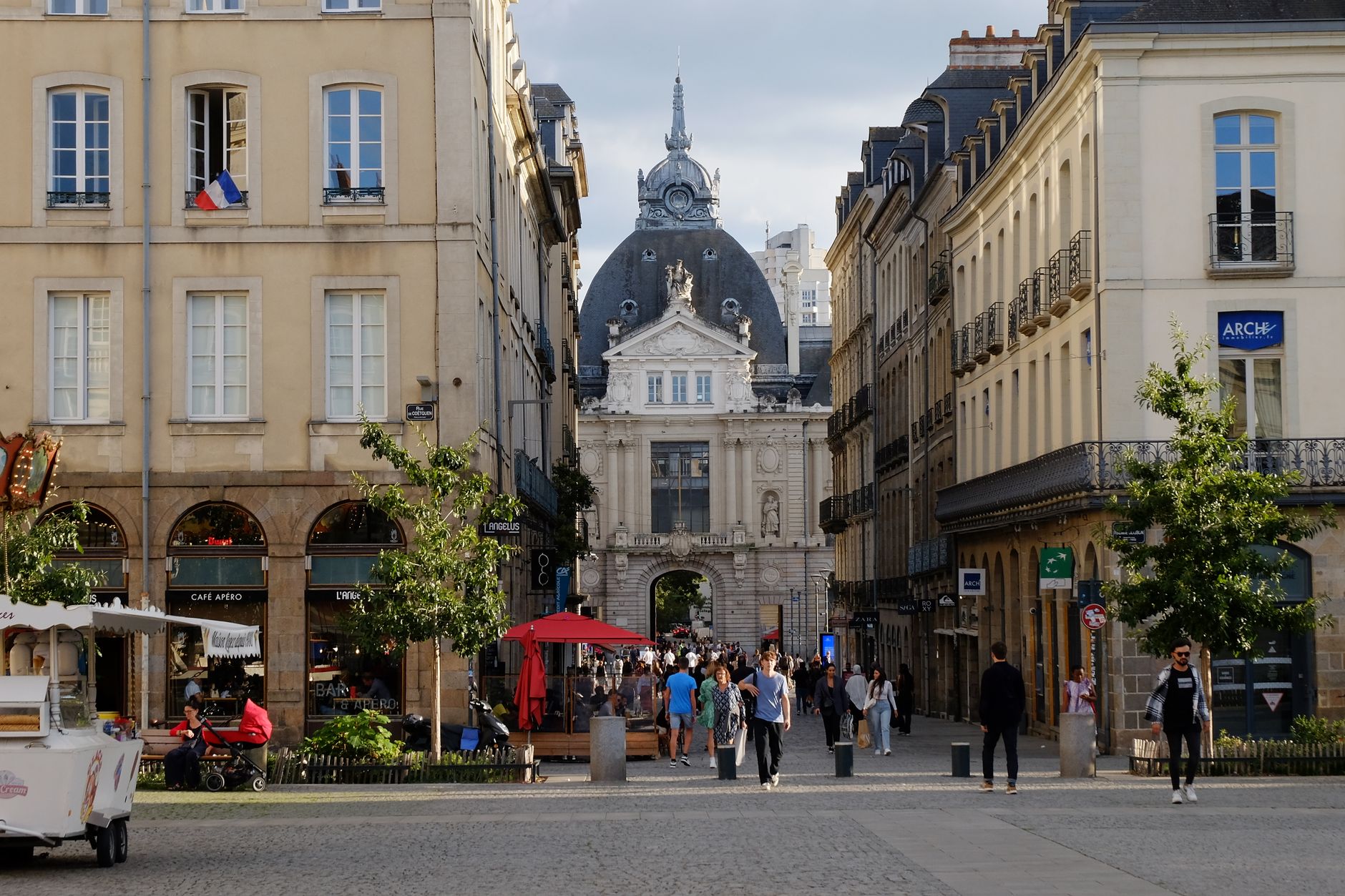
Six kilometres east of central Paris, Montreuil runs uphill from a dense fabric of old brick workshops and converted lofts to a ridge where a twelfth-century church still anchors the skyline. The name goes back to a royal edict of 722 — Monasteriolum, "little monastery" — and layers of that long life show up in unexpected corners: gypsum-coated orchard walls that once fed peaches to Versailles, a water tower left over from a Pernod factory, and a mural of Frantz Fanon on a boulevard in Bas-Montreuil.
For much of the twentieth century, Montreuil was a working-class commune with 755 factories at its peak. The lower town, Bas-Montreuil, still carries that grain — low-rise millstone and brick buildings now housing studios, third places, and the global headquarters of Ubisoft. It sits inside the Paris metro network but operates on its own logic.
💛 What travellers fall for
People who come back tend to anchor around Bas-Montreuil on a Sunday morning: the Puces de Montreuil flea market for hardware, vinyl, and old clothing, then a slow walk through the Murs à Pêches — the restored walled orchard gardens in the Saint-Antoine quarter, where the gypsum walls still radiate a faint warmth on cool afternoons.
Deals in Montreuil
Book directly at the provider
How Montreuil came to be
The settlement that became Montreuil grew around a Merovingian monastery on a hill above Vincennes — first documented in 722, when it appeared in a royal edict as Monasteriolum. For centuries it remained agricultural, but between roughly 1600 and 1900 it became something stranger: a third of its area was given over to walled orchards whose gypsum-plastered walls trapped and radiated heat, growing peaches, cherries, and strawberries for the royal court at Versailles.
The industrial turn came in the nineteenth century, and by the early twentieth Montreuil had drawn the pioneers of cinema. Georges Méliès built what is considered the world's first purpose-built film studio here in 1897, where he shot Trip to the Moon in 1902. The Lumière brothers had workshops nearby, and Émile Reynaud — inventor of the praxinoscope, forerunner of the animated film — worked in the same orbit. The studio was demolished in 1945. A later wave of Russian émigré filmmakers operated out of Studio Pathé Albatros from 1917 for a decade, leaving a distinct mark on European silent cinema.
Who and what shaped it
People who shaped it
Landmark buildings
See Montreuil in motion
Plan your visit
On the map
When to go
Summer runs warm and agreeable, with temperatures between 20°C and 26°C and enough sunshine to make the orchard walks genuinely pleasant from June through August. Winter is grey and damp — December averages under two hours of daylight and is the wettest month — though the flea market and the indoor stops at the Hôtel de Ville or the Musée de l'Histoire Vivante give you reasons to visit year-round.
Right now
Background & history adapted from Wikipedia (CC BY-SA) · specs from Wikidata (CC0) · weather from Open-Meteo · map data © OpenStreetMap contributors · photos from Wikimedia Commons / Unsplash with per-image credit. No third-party reviews or social posts reproduced.