
Mediapark
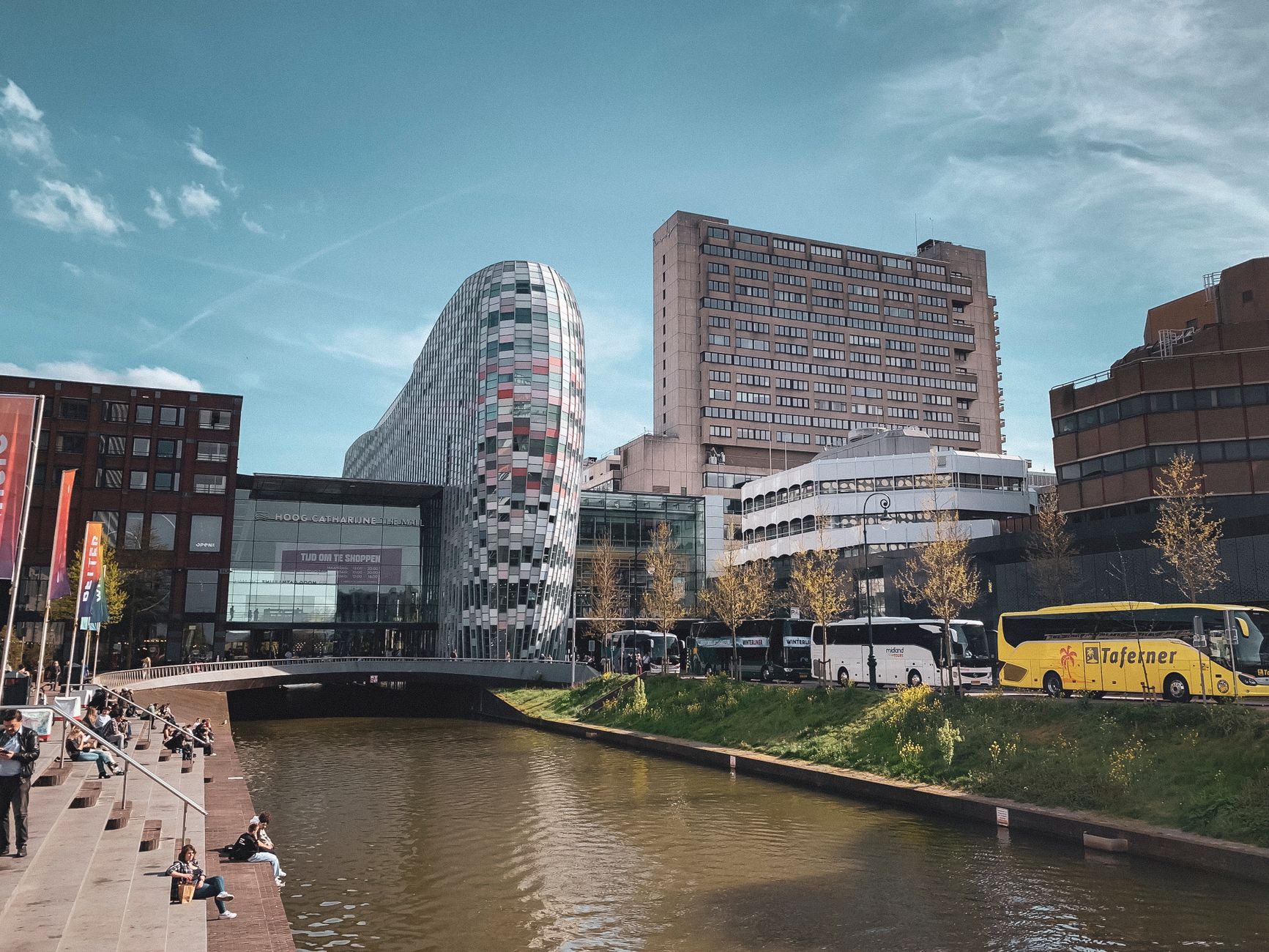
The KölnTurm gives you your bearings immediately: 148 metres of Jean Nouvel glass, its surface screen-printed with images of other Cologne buildings, rising above a neighbourhood that didn't exist before the 1990s. Mediapark occupies the former Gereon railway yard in Neustadt-Nord — about 20 hectares of old freight infrastructure that Canadian architect Eberhard Zeidler reconceived as a star of award-winning buildings arranged radially around a central square, separated from traffic by a small lake.
The result is a working media district — around 3,000 people come here daily across 250 companies — that also functions as a genuine public space. The 16,000-square-metre central square hosts open-air concerts and cultural events, and the Cinedom multiplex and German Dance Archive sit alongside cafés and two hundred apartments.
💛 What travellers fall for
People who come back tend to time it for an outdoor event on the central square, when the lake and the Nouvel tower make an unlikely but coherent backdrop. The U-Bahn stop at Christophstraße/MediaPark drops you almost at the water's edge — skip the car, even with 2,500 underground spaces on offer.
Deals in Mediapark
Book directly at the provider

How Mediapark came to be
The ground beneath Mediapark spent much of the twentieth century moving freight. The Gereon railway yard served Cologne's industrial logistics until the city began rethinking what post-industrial land in Neustadt-Nord could become. In 1990 the project got underway, with Eberhard Zeidler appointed to design the overall scheme — a deliberate clustering of media, communications and cultural tenants around shared public space.
Construction ran from 1992 to 2004, with individual architects contributing distinct buildings within Zeidler's framework. Jean Nouvel completed the KölnTurm in 2001; Herman Hertzberger designed Block 5 between 2000 and 2004. Institutions like the SK Stiftung Kultur and the German Dance Archive moved in alongside broadcasters and tech firms, giving the district a cultural weight that pure office development rarely achieves.
Who and what shaped it
People who shaped it
Landmark buildings
See Mediapark in motion
Plan your visit
On the map
When to go
Summer brings mild warmth with a North Sea influence and fairly regular rainfall, so a light layer is worth keeping close. Autumn is statistically the driest season, making September a particularly reliable window; winter temperatures hover just above freezing, and snow is possible as late as early April.
Right now
Background & history adapted from Wikipedia (CC BY-SA) · specs from Wikidata (CC0) · weather from Open-Meteo · map data © OpenStreetMap contributors · photos from Wikimedia Commons / Unsplash with per-image credit. No third-party reviews or social posts reproduced.