
Madonna di Campiglio
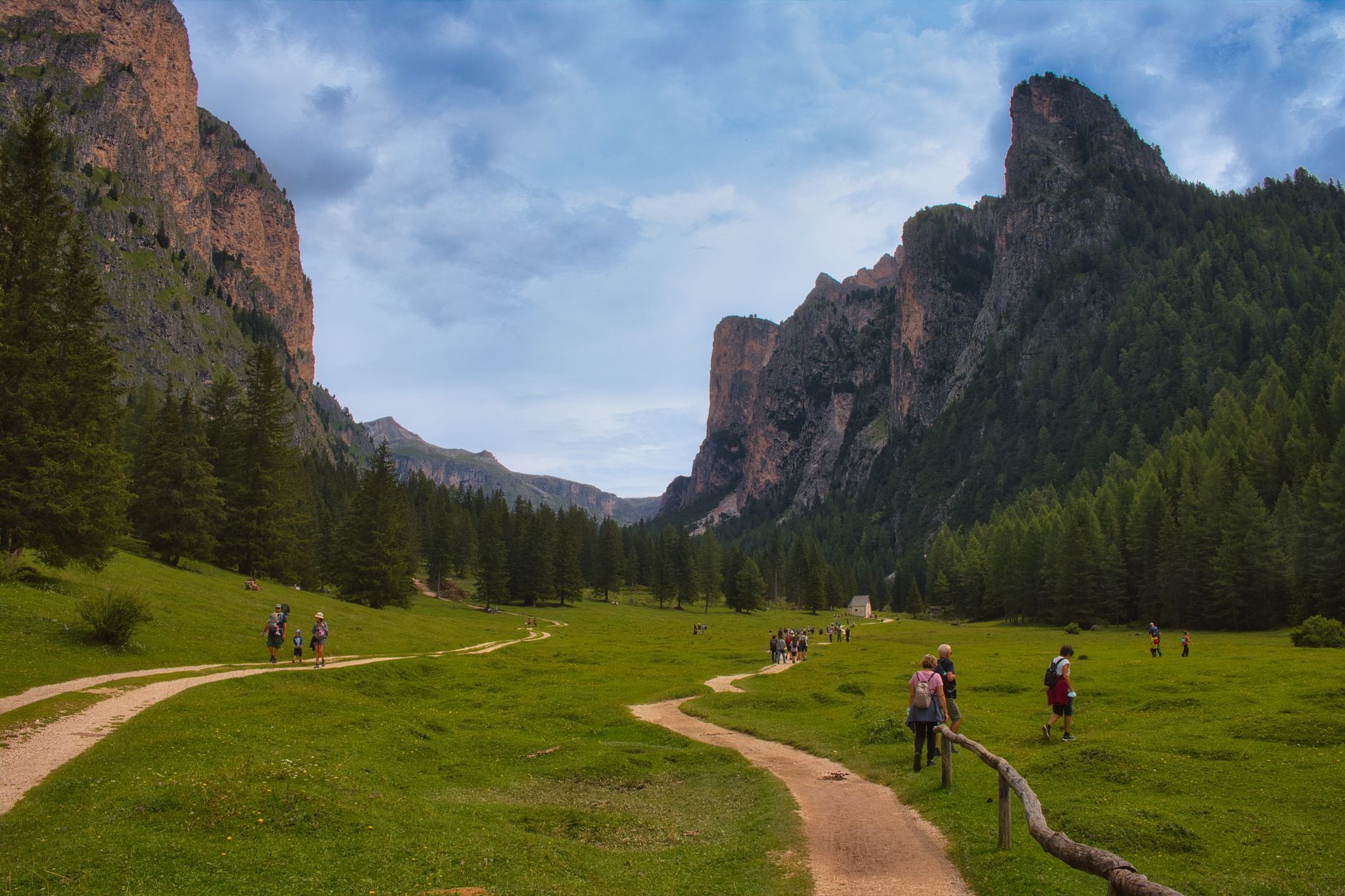

At 1,550 metres, Madonna di Campiglio sits in the Val Rendena with the jagged limestone towers of the Brenta Dolomites on one side and the glaciers of the Adamello-Presanella on the other. The light here does something particular in the late afternoon — it turns the rock faces amber while the valley floor stays in shadow, and you notice it whether you're on skis or just walking back from the lake.
This is one of the more seriously developed Alpine resorts in Italy, shaped by a long line of builders and hoteliers who each added a layer: the hospice, the carriage road, the grand hotel, the chairlift, the golf course. What you find now is a place with real historical texture beneath the polished surface.
💛 What travellers fall for
People who come back tend to seek out the Salone Hofer in the Grand Hotel Des Alpes — the Liberty-style dining hall decorated in 1896 whose Habsburg-era murals most guests walk past without a second look. The Canalone Miramonti run rewards those who check the snow conditions carefully; it's steep enough that the first World Cup held in Italy took place here in 1967.
Experiences you don't want to miss


Deals in Madonna di Campiglio
Book directly at the provider
How Madonna di Campiglio came to be
The place began as an act of charity. Around 1180, a layman named Raimondo built a small hospice to shelter Alpine pilgrims, alongside a chapel to the Virgin Mary — a 1222 manuscript already calls it the 'Hospital of the most glorious Mother of God.' That religious foundation gave the resort half its name.
The modern story starts in 1868, when Giambattista Righi of Strembo built the first hotel and, at his own expense, cut a carriage road connecting the valley. After his death in 1882, his heirs sold to Franz Josef Oesterreicher, who transformed the property into the Grand Hotel Des Alpes by 1886. Between 1889 and 1894, Emperor Franz Joseph and Empress Elisabeth stayed here. A group of British skiers arrived in 1910 and confirmed what the mountaineers — whose association had been active since 1872 — already knew about the terrain. The first ski lift came in the mid-1930s, the first chairlift in 1948.
Who and what shaped it
People who shaped it
Landmark buildings
See Madonna di Campiglio in motion
Plan your visit
On the map
When to go
Winters are cold and reliably snowy from December through March, with temperatures frequently dropping well below freezing at night. Summers are mild and bright, rarely oppressive at this elevation, though afternoon thunderstorms are common across July and August.
Right now
Background & history adapted from Wikipedia (CC BY-SA) · specs from Wikidata (CC0) · weather from Open-Meteo · map data © OpenStreetMap contributors · photos from Wikimedia Commons / Unsplash with per-image credit. No third-party reviews or social posts reproduced.