
Lehel
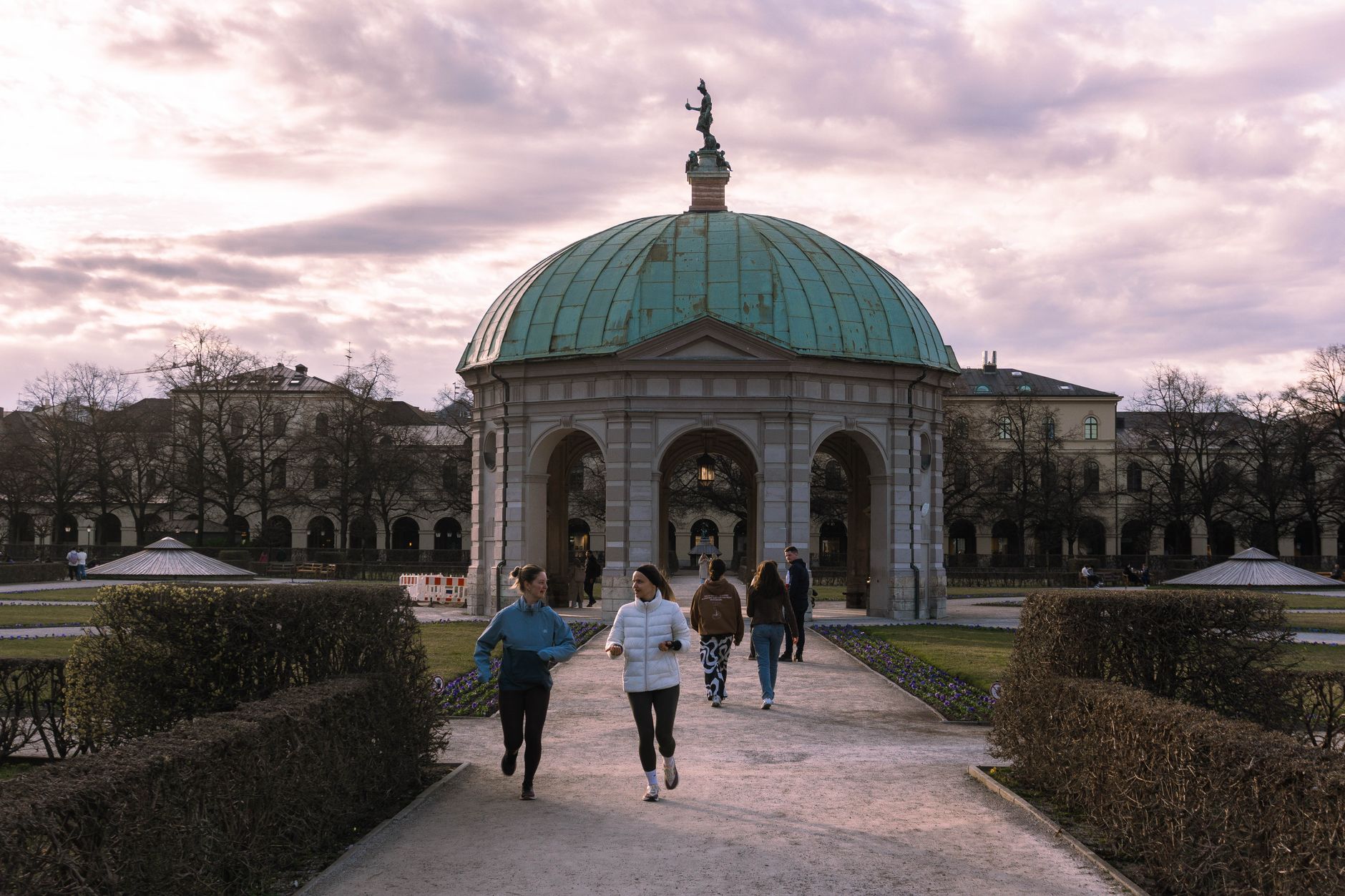

Lehel sits between the old city, the Isar and the Englischer Garten in a way that makes it feel like Munich's quiet pressure valve. The streets around St.-Anna-Platz still carry the proportions of a working neighbourhood — wide enough for the old rafting trade that once made this stretch of river one of the largest departure points in Europe, sending passengers downstream to Passau or Vienna. The Wilhelminian apartment houses that replaced those riverside workshops now sell for considerable sums, but Lehel wears its wealth without much fuss.
Prinzregentenstrasse runs through the quarter like a cultural spine: the Bavarian National Museum at one end, the Haus der Kunst at the other, the Schackgalerie somewhere in between. Museums aside, the pleasure of Lehel is largely in the walking — past addresses where Rilke, Wedekind and Karl Valentin once kept rooms.
💛 What travellers fall for
People who know Lehel well tend to anchor their day at St.-Anna-Platz before the cafés fill, then walk the length of Prinzregentenstrasse at their own pace. The Bavarian National Museum rewards a second visit more than a first — once you stop trying to see everything, the individual halls, each designed around the objects inside them, start to make sense.
Deals in Lehel
Book directly at the provider


How Lehel came to be
The name comes from a Bavarian diminutive for a small alluvial forest — the patch of low-lying land between the Isar and the old city where, by the 16th century, millers, washers, bakers and raftsmen had built their livelihoods. The rafting grounds here were once among the largest in Europe. Munich absorbed Lehel officially in 1724, and for much of the 19th century it remained what it had always been: a quarter for people who worked with their hands.
The shift came from two directions at once. King Maximilian II commissioned architect Georg Friedrich Bürklein to build Maximilianstrasse from 1853 onwards, bringing a new architectural idiom — part English neo-Gothic, part Italian — straight through the neighbourhood. Then, at the turn of the 20th century, the bourgeoisie arrived with Wilhelminian apartment houses, and writers followed: Rilke at Widenmayerstrasse 32, Wedekind at Prinzregentenstrasse 50, Karl Valentin on Kanalstrasse from 1909. Gentrification accelerated hard in the 1980s and has not reversed.
Who and what shaped it
People who shaped it
Landmark buildings
See Lehel in motion
Plan your visit
On the map
When to go
Munich winters are cold and often grey from November through February, but Lehel's museum density makes it a reasonable season to visit. Spring and early autumn are the most comfortable for walking the quarter's streets, when the trees along the Isar embankment are at their best.
Right now
Background & history adapted from Wikipedia (CC BY-SA) · specs from Wikidata (CC0) · weather from Open-Meteo · map data © OpenStreetMap contributors · photos from Wikimedia Commons / Unsplash with per-image credit. No third-party reviews or social posts reproduced.