
Kursaal Congress Centre and Auditorium

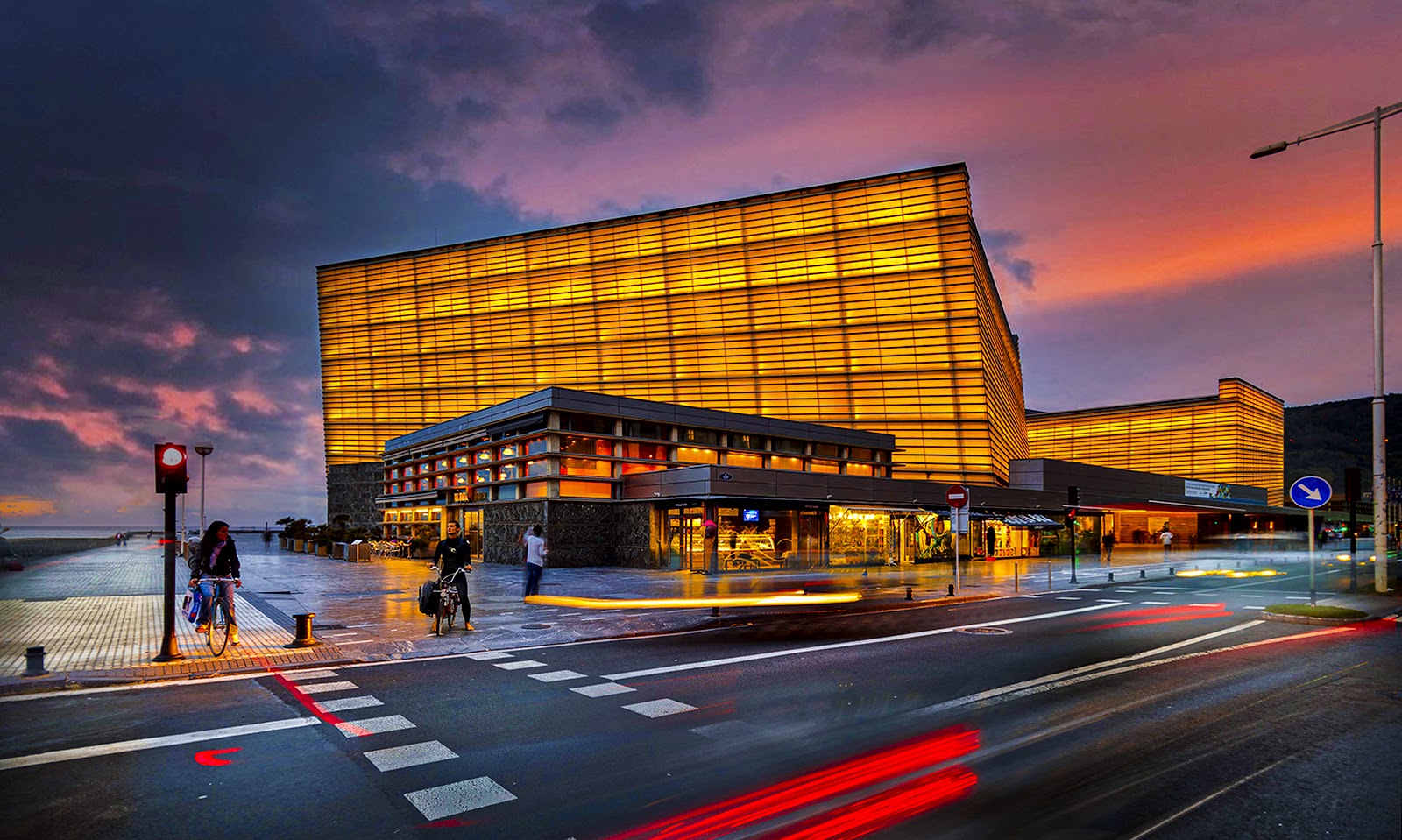
Two large glass cubes sit at the mouth of the Urumea River, tilted — five degrees vertically, three degrees horizontally — as if they arrived from the sea and simply stopped. By day they read as milky white; after dark, the 1,500-square-metre LED facade shifts through colours, making the building a kind of slow, silent broadcast to the Gros neighbourhood across the water.
Rafael Moneo called his design 'Two Stranded Rocks', and the metaphor holds. The larger cube houses a 1,806-seat auditorium lined in wood; the smaller one a 600-seat chamber hall. Together they anchor the cultural calendar of San Sebastián — the Film Festival, Jazzaldia, the Musical Fortnight — drawing over 600,000 people a year through their doors.
💛 What travellers fall for
People who return tend to time an evening arrival: the walk along Paseo Zurriola as the facade begins to glow is its own event, separate from whatever is on inside. The terrace over the river mouth is worth seeking out even if you have no ticket — the view back toward Monte Urgull and the Old Town is one of the better ones in the city.
The story behind Kursaal Congress Centre and Auditorium
A grand casino called the Gran Kursaal opened on this site on 29 July 1922, only to lose its gambling licence two years later when Primo de Rivera's dictatorship banned the practice. The building limped on in diminished form until it was demolished in 1972, leaving the river mouth without a focal point for nearly three decades.
In spring 1990, San Sebastián City Hall organised an invitational competition that drew Mario Botta, Norman Foster, Arata Isozaki and others. Rafael Moneo — born in Tudela in 1937, trained partly alongside Jørn Utzon during the Sydney Opera House years — won with 'Two Stranded Rocks'. The project was drafted between 1991 and 1994, construction ran from 1996 to 1999, and the building opened on 23 August 1999 with a concert by the Basque Country Symphony Orchestra and soprano Ainhoa Arteta. Moneo received the Pritzker Prize in 1996; the Kursaal was awarded the European Union Prize for Architecture — Mies van der Rohe — in 2001. Early local opinion was divided, but the building's cultural and economic pull gradually shifted the conversation.

Good to know
The exterior and public terraces are free to visit any time. The ticket office opens weekday mornings year-round (11:30–13:30), with afternoon hours on concert days. Bus lines 8, 17 and 41 stop at Zurriola 36; there is underground parking on site. Check the programme before you go — the building earns its interior.
Where is Kursaal Congress Centre and Auditorium?
More tickets & tours for Kursaal Congress Centre and Auditorium
Book directly at the provider
What travellers say about Kursaal Congress Centre and Auditorium
I wrote a review about Plaza de Torres yesterday that was really critical so I thought it would only be fair to write a review about our experience at the symphony at this gorgeous concert hall - Kursaal. This is an astounding property with a gorgeous location, fantastic sound, helpful staff, extremely comfort seating and climate. The performance of the orchestra and choir was top notch as well.
An impressive Congress Centre with a large main hall that easily fits more than 750 people as well as many other medium and smaller size meeting rooms. The terrace offers an impressive seaview but wind and weather determine if it is useful. The infrastructure is solid.
A fantastic location for events. Views are breathtaking and the theatre is superb. Located right beside the sea and close to the centre of San Sebastian
The Great Kursaal was an elegant palace built in 1921, pulled down in 1973. An empty plot was freed (1973-1999). The new Kursaal Congress Centre (1999) was designed by Rafael Moneo, awarded the European Union Prize for Contemporary Architecture in 2001. The initial impact of the buildings in the landscape was deemed negative by Donostians, thanks to the positive impact it had in the economy, tourism and cultural life, most citizens today appreciate it.
Absolutely beautiful place. A stunning conference venue.
More of San Sebastián
Discover where to stay, what to do and the best deals for your trip.
Explore San Sebastián →More attractions in San Sebastián
All of San Sebastián →

Background adapted from Wikipedia (CC BY-SA) · map data © OpenStreetMap contributors · ratings & place photos via Google · other photos with per-image credit. Ticket links may earn us a commission at no extra cost to you.