
Hervás
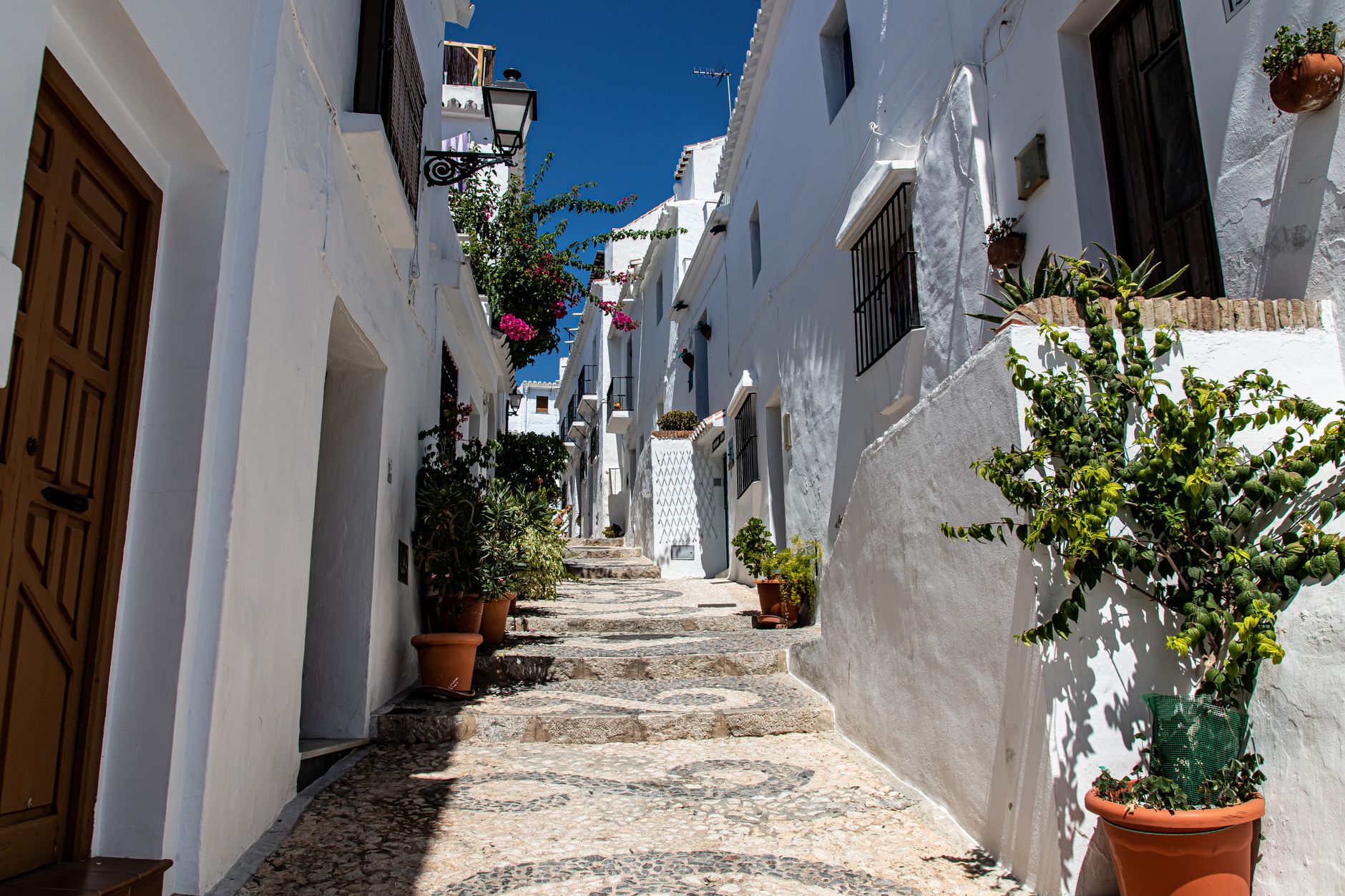
The narrowest street in Spain is roughly the width of your shoulders — about fifty centimetres of whitewashed passage threading through Hervás's old Jewish quarter, and you'll likely turn sideways without thinking. That reflex tells you something about the scale of this small Extremaduran town in the Ambroz valley: it rewards attention paid to the particular rather than the panoramic.
Hervás grew up around a Templar hermitage in the thirteenth century and took on a second layer of identity after 1361, when Jewish families — weavers, merchants, a rabbi, doctors — began settling here under the protection of the Duke of Béjar. The adobe-and-chestnut-timber houses, the 1395 stone bridge over the Ambroz, the streets etched with Stars of David: the town carries that layered past in its fabric, even where the history is contested.
💛 What travellers fall for
People who come back tend to do so in autumn, when the chestnut trees along the Ambroz turn and the crowds thin. The Puente de la Fuente Chiquita at dusk is worth the detour, and regulars know to look for house number 19 on Calle Rabilero, where tradition places the old synagogue — no plaque, just the address.
Experiences you don't want to miss



Deals in Hervás
Book directly at the provider


How Hervás came to be
The town traces its name to a Templar hermitage dedicated to the martyrs Gervasius and Protasius, built in the twelfth century. Hervás developed through the thirteenth and fourteenth centuries as part of the lordship of Béjar in Castile, and the Iglesia Parroquial de Santa María — begun in the thirteenth century on the site of the Templar fortress — still anchors the upper town.
In 1361 Jewish families began arriving, and by 1450 forty-five households had settled here, their surnames — Abenfariz, Cohen, Escapa, Orabuena — documented in the records. The 1492 edict of expulsion forced conversion or exile; some converted outwardly and continued practicing in private for years afterward. The town joined the Network of Jewish Quarters of Spain in 1995, though historians note that the boundaries of the current 'Jewish quarter' may not map precisely onto where those families actually lived.
Who and what shaped it
People who shaped it
Landmark buildings
See Hervás in motion
Plan your visit
On the map
When to go
Hervás has a soft continental climate: summers are warm and dry, with July days reaching 30°C and only a handful of rainy afternoons; winters are cool and damp, with January nights dropping to around 1°C. October is the wettest month, but also one of the most atmospheric for a visit — expect about 150 mm across the month alongside mild daytime temperatures.
Right now
Background & history adapted from Wikipedia (CC BY-SA) · specs from Wikidata (CC0) · weather from Open-Meteo · map data © OpenStreetMap contributors · photos from Wikimedia Commons / Unsplash with per-image credit. No third-party reviews or social posts reproduced.