
Gibralfaro Castle
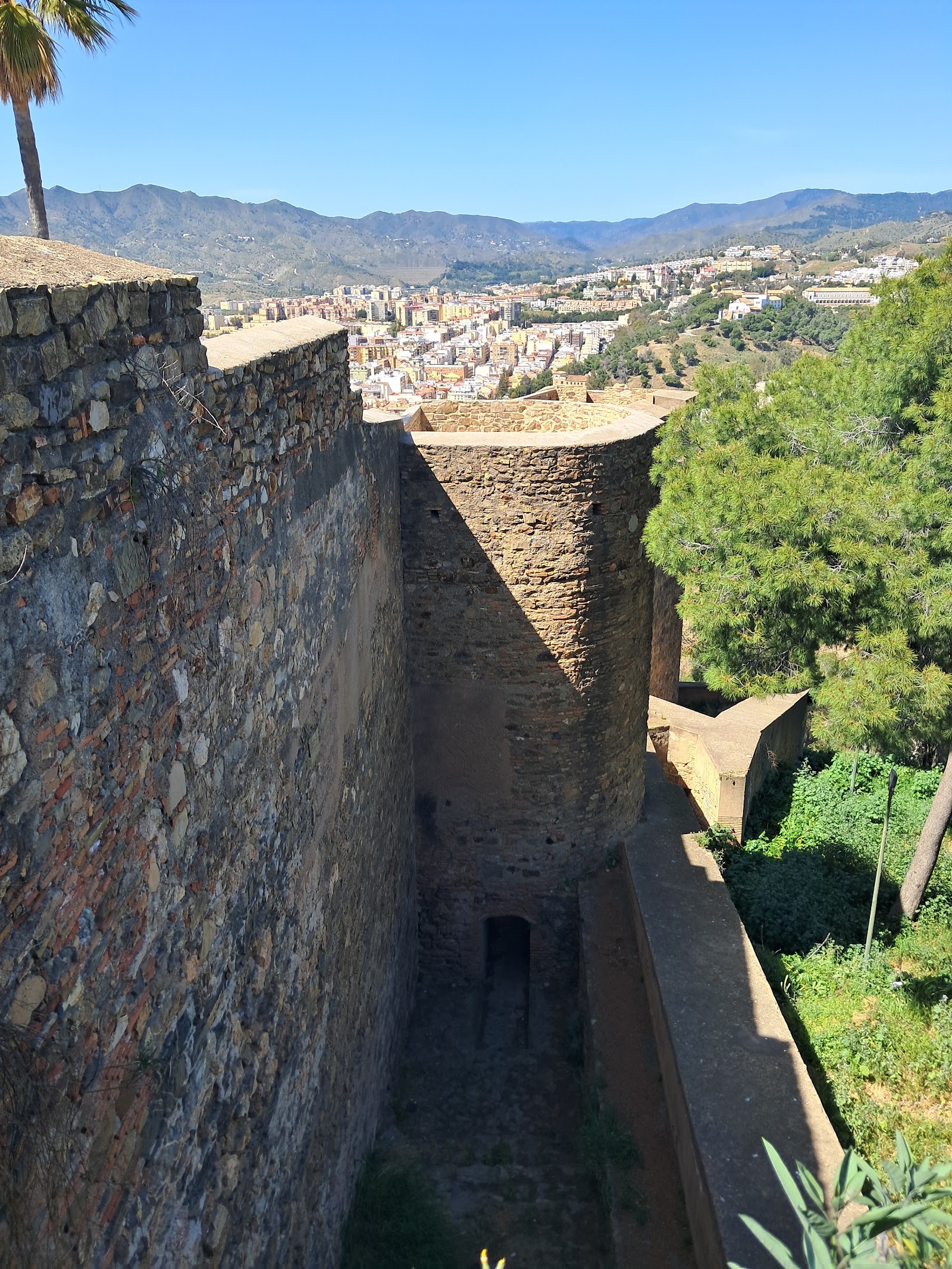
At 132 metres above the city, Gibralfaro's ochre walls come into view long before you reach them — a ridge-top fortress that has been watching over Málaga since the Phoenicians first raised a lighthouse here around 770 BC. The walk up through pine trees along the old Coracha corridor gives you a sense of the castle's logic: this was a place built to control movement, to shelter armies, to hold a city.
Once inside, the scale surprises. Over 1,300 metres of walls, eight solid towers, and at the centre an octagonal cistern cut from living rock — engineering that outlasted every political order that ever claimed this hill.
💛 What travellers fall for
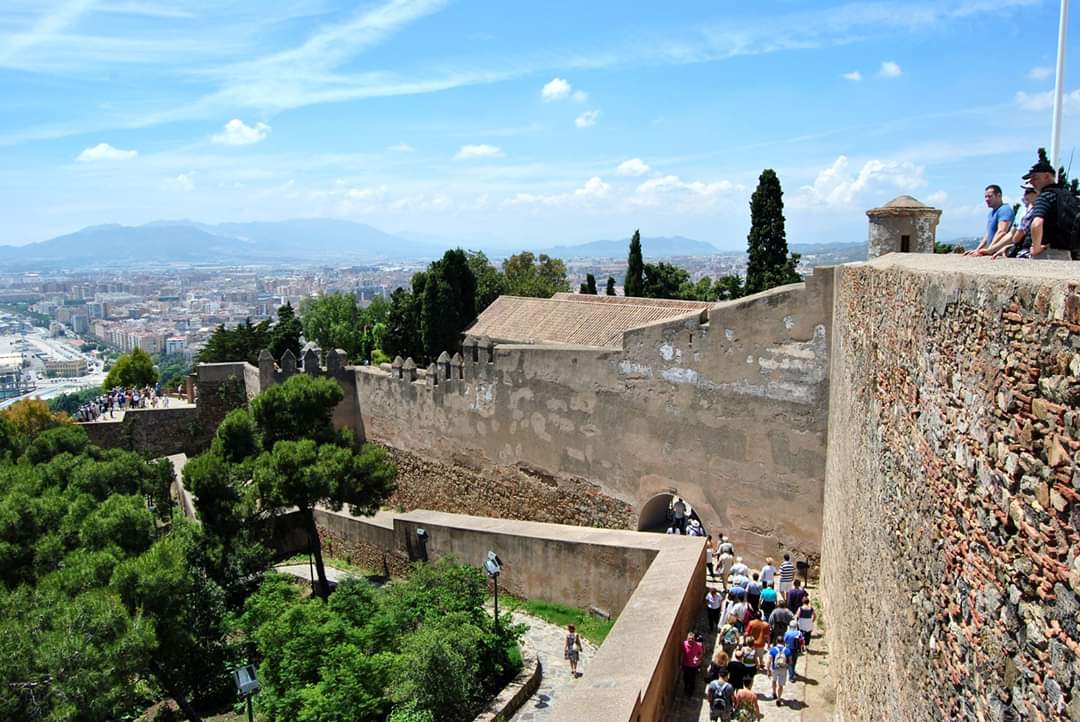
People who come back tend to time it for late afternoon, when the light on the bay turns soft and the cruise ships below look like toys. The wall-walk between the towers is the thing — you can circle almost the entire perimeter, and the view shifts with each section: city, sea, mountains, port. Bring water; there's no café inside.
The story behind Gibralfaro Castle
The site's first stone belongs to the Phoenicians, who founded Málaga around 770 BC and likely used the promontory as a beacon point. Caliph Abd-al-Rahman III of Córdoba fortified it in 929 CE, but the castle you walk through today is largely the work of Yusuf I of Granada, who ordered its construction between 1344 and 1354 — explicitly to protect the Alcazaba below and quarter his troops.
In 1487, Ferdinand and Isabella besieged it for three months; hunger, not force, brought the garrison to surrender. The mosque became a church dedicated to Saint Louis of Toulouse. The French did considerable damage during the War of Independence in 1812, demolishing the Torre Nueva and the gunpowder store among other structures. The former magazine now houses the Interpretation Centre, opened in 1998.
Good to know
Bus 35 from the city centre drops you close; the uphill walk from the Alcazaba via Paseo de Don Juan Temboury takes about 20 minutes through pine shade. Note that the two fortresses share no internal connection — separate entrances, separate tickets, though a combined ticket (€5.50) saves money. Free entry Sundays from 14:00.
Spring and autumn are the most comfortable seasons for the exposed wall-walk — March through May offers mild temperatures and long clear days, while October stays warm without the full weight of summer. July and August push past 30°C on the hilltop with little shade; winter days can be bright and pleasant around 18–20°C, though rain arrives in spells between November and March.
Where is Gibralfaro Castle?
More tickets & tours for Gibralfaro Castle
Book directly at the provider
What travellers say about Gibralfaro Castle
Stunning views beautiful landscape, love the view of the city of Malaga. The climb up is challenging you must wear running shoes, on this walk up I saw heels, sandals, flip flops everything you should not be wearing. You need full support walking up a very steep hill plus going down you can easily slip and fall. I recommend water, a hat and taking breaks if you need it. It took us about 30 minutes to walk up some could take longer however just enjoy the views the breaks. As you walk up you can buy magnets 1 for 2 euros, hats gadgets I also got earrings for $3.00 euros I wish I would have bought two pairs that’s a deal. Once you reach the top there’s also a great lookout view. When you get to see the Gibralfaro there’s a stand for water and snacks. We purchased our two combo tickets with the Alcazaba. The walk was great inside took many great photos just walking the grounds was breathtaking. I highly recommend seeing this place.
There is a small museum inside with some historical artifacts. The best thing here is walk on the walls, which are surrounding the whole Gibralfaro complex and the view is breathtaking. Going up on foot is a bit challenge during hot days for those not in shape, I guess not suitable for flip-flops but otherwise it’s nothing too difficult. Good news is, there is a bar in the middle of the castle. There is also bus line but its schedule is not frequent so better by taxi or tuk-tuk.
Nice place to visit with great views of the city but be VERY careful with your bags as my wife, who is very safety conscious, had her purse stolen here and it wasn't even that busy....I suspect the risk will increase in the summer months with more visitors around. Just goes to show that paying to visit somewhere doesn't improve your safety.
A must do! The views are unbeatable for the center of Malaga. You can take the 35 bus up or walk up. The walk- climb took about 20 minutes. All nicely paved. Go near sunset! Cooler and most beautiful.
Beautiful hike up to a nice scenic view point. Definitely worth it, there is a small gallery within the compound showing the history from 16th to 19th century. The surrounding areas outside the wall are publicly accessible but the main compound requires a ticket. Combined tickets with Alcazabar are available at 10€ (as of May 2026) at self service kiosks. Some sections are rather steep and while there are sloped areas, this is not recommended for those with mobility restrictions. Some level of physical fitness required.
More of Málaga
Discover where to stay, what to do and the best deals for your trip.
Explore Málaga →More attractions in Málaga
All of Málaga →

Background adapted from Wikipedia (CC BY-SA) · map data © OpenStreetMap contributors · ratings & place photos via Google · other photos with per-image credit. Ticket links may earn us a commission at no extra cost to you.