
Feuchtwangen
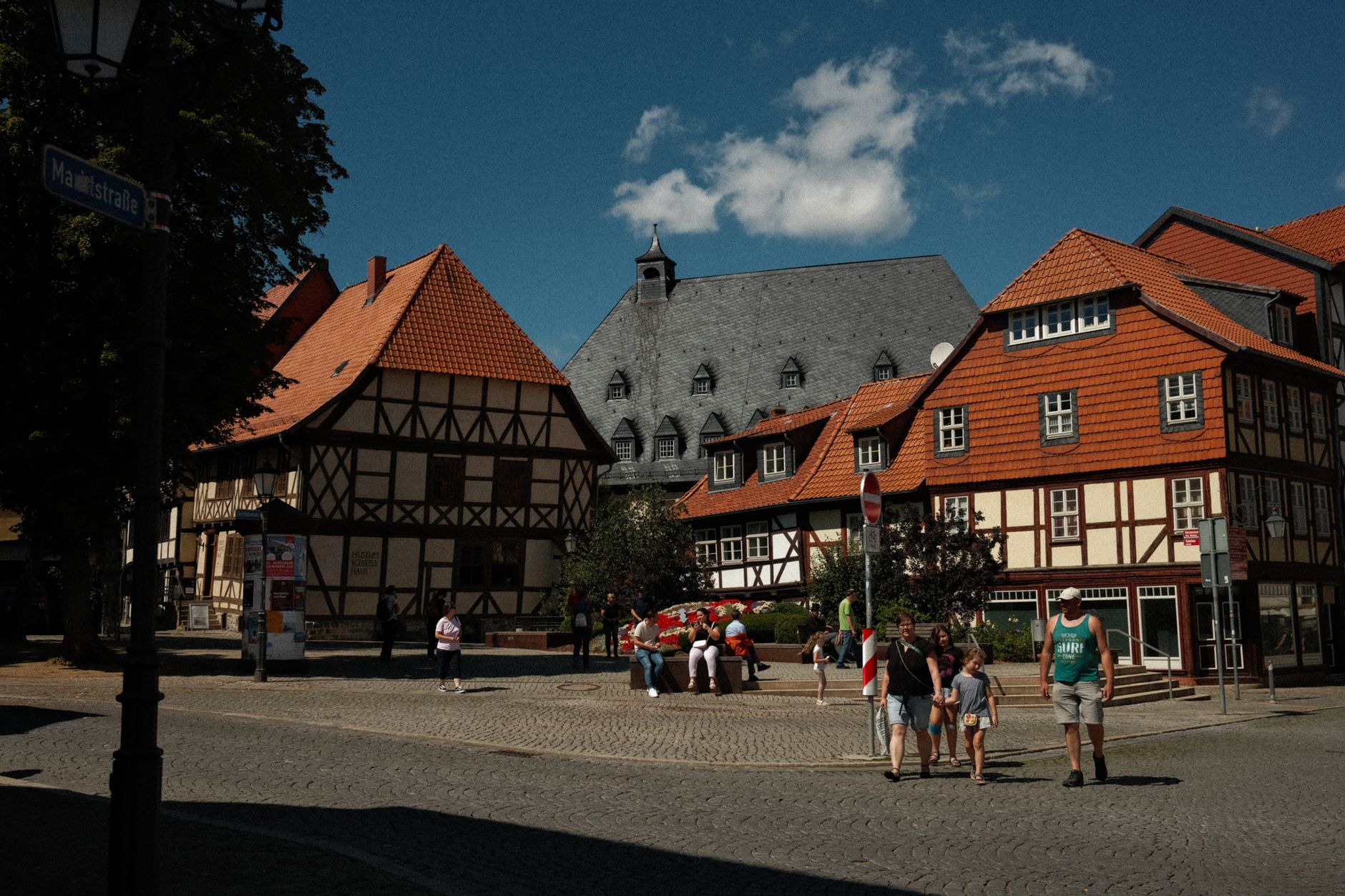
Stand in Feuchtwangen's Marktplatz on a summer evening and you'll understand why locals call it Franconia's Festival Hall — the half-timbered facades curve around the square like theatre wings, and since 1949 the Romanesque cloister just behind has hosted open-air performances under the same sandstone arches where medieval monks once walked. The Baroque fountain from 1726 anchors the centre, and the whole ensemble is compact enough that you can cross the old town in ten minutes.
What slows you down is the detail. Six complete craftsmen's workshops — dyer, pewterer, weaver and more — survive intact in the cloister's west wing. The Franconian Museum holds over two thousand square metres of folk furniture and decorated household objects. Germany's most comprehensive choir museum, the Sängermuseum, occupies a building most visitors walk straight past.
💛 What travellers fall for
People who come back tend to time a visit around the Kreuzgangspiele theatre festival, mid-June to mid-August, when the cloister fills with an audience at dusk. The craftsmen's workshops in the cloister west wing are guided-tour only — worth booking ahead rather than hoping to slip in.
Deals in Feuchtwangen
Book directly at the provider
How Feuchtwangen came to be
A Benedictine monastery was recorded here as early as 818/19, and the Staufer emperors turned the settlement into a town between roughly 1150 and 1178. By 1241 Feuchtwangen held the status of imperial free city — a distinction it lost in 1376 when it was pledged to the Burgravate of Nuremberg. The two communities, monastic and civic, were eventually enclosed within a shared wall around 1400, of which the Obertor gate still stands.
The medieval fabric has survived remarkably intact. The Romanesque cloister dates to the second half of the 12th century; the Stiftskirche's Gothic choir and its carved stalls, made by Swabian and Franconian craftsmen around 1500, came later. Michael Wolgemut — the Nuremberg painter who would go on to teach Albrecht Dürer — completed the Altar of Our Lady here in 1484. Two Grand Masters of the Teutonic Knights, Konrad and Siegfried von Feuchtwangen, took their names from the town.
Who and what shaped it
People who shaped it
Landmark buildings
See Feuchtwangen in motion
Plan your visit
On the map
When to go
Summer is the natural season to visit: July averages nearly eight hours of sunshine a day and temperatures sit comfortably between 20 and 26°C, though it's also the wettest month. Winter is genuinely cold, often snowy and mostly overcast, with January nights dropping to around -2°C.
Right now
Background & history adapted from Wikipedia (CC BY-SA) · specs from Wikidata (CC0) · weather from Open-Meteo · map data © OpenStreetMap contributors · photos from Wikimedia Commons / Unsplash with per-image credit. No third-party reviews or social posts reproduced.