
Derry (Londonderry)
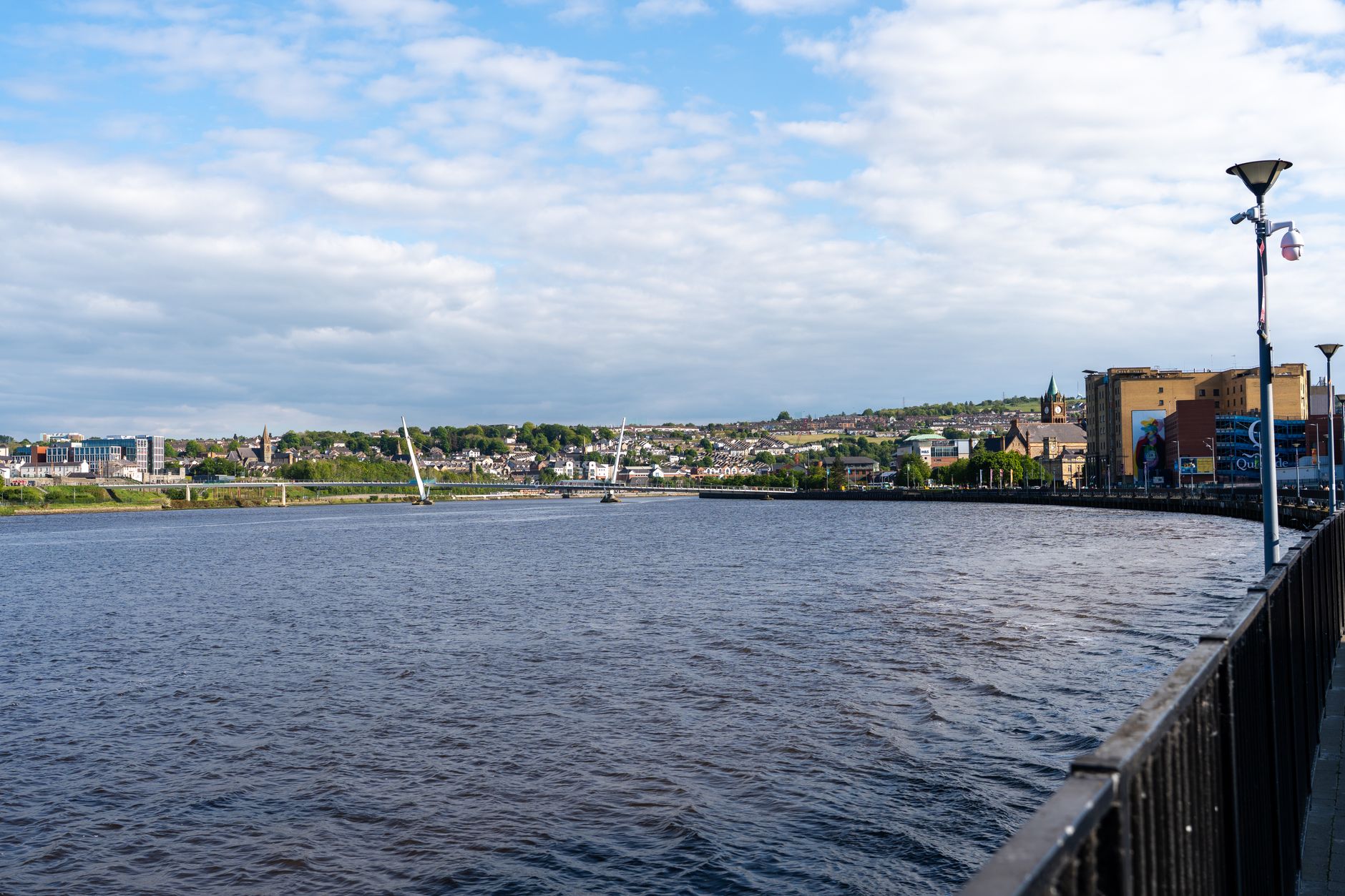
Derry is the only completely walled city in Ireland, and the walls — 1.5 kilometres of stone up to 35 feet wide, built between 1613 and 1619 — are still free to walk. You can circle the entire inner city on foot in under an hour, looking down into the Bogside on one side and back across rooftops toward the River Foyle on the other. The name comes from the Irish *Daire*, meaning oak-grove, and the place has been continuously inhabited since St Columcille founded a monastery here in 546 AD.
The city carries two names — Derry and Londonderry — and both are used, a fact that tells you something about its history before you've read a word of it. That history is dense and specific: sieges, plantation charters, apprentice boys, linen mills. It rewards people who slow down.
💛 What travellers fall for
People who come back tend to walk the walls first thing in the morning, before the tour groups arrive, and end up at St Columb's Cathedral to see the original gate keys from the 1689 siege in the Chapter House. The Guildhall's stained glass is worth the detour — the collection is genuinely large and the building itself has been burned and bombed and rebuilt twice.
Deals in Derry (Londonderry)
Book directly at the provider
How Derry (Londonderry) came to be
The site's first chapter belongs to St Columcille, who established a monastery on the west bank of the Foyle in 546 AD. Centuries later, in 1608, the town was burned during O'Doherty's Rebellion. James I chartered it in 1613 as a plantation settlement funded by the City of London guilds — hence the name Londonderry — and by 1619 the stone walls were complete, 24 feet high and enclosing the city entirely.
The walls were never breached. During the Siege of 1689, thirteen apprentice boys famously closed Ferryquay Gate against the Jacobite army on 7 December 1688; the city held out for 105 days, earning its nickname 'The Maiden City'. By the 1850s, linen shirt-making had become the economic engine. In 1932, Amelia Earhart landed near Derry after completing the first solo transatlantic flight by a woman. In 2013, the city became the inaugural UK City of Culture.
Who and what shaped it
People who shaped it
Landmark buildings
See Derry (Londonderry) in motion
Plan your visit
On the map
When to go
Derry is wet year-round — expect rain regardless of season. Summers are mild and grey with occasional bright spells; winters are cold and damp but rarely severe. April through October gives the longest daylight hours for walking the walls.
Right now
Background & history adapted from Wikipedia (CC BY-SA) · specs from Wikidata (CC0) · weather from Open-Meteo · map data © OpenStreetMap contributors · photos from Wikimedia Commons / Unsplash with per-image credit. No third-party reviews or social posts reproduced.