
Clausthal-Zellerfeld
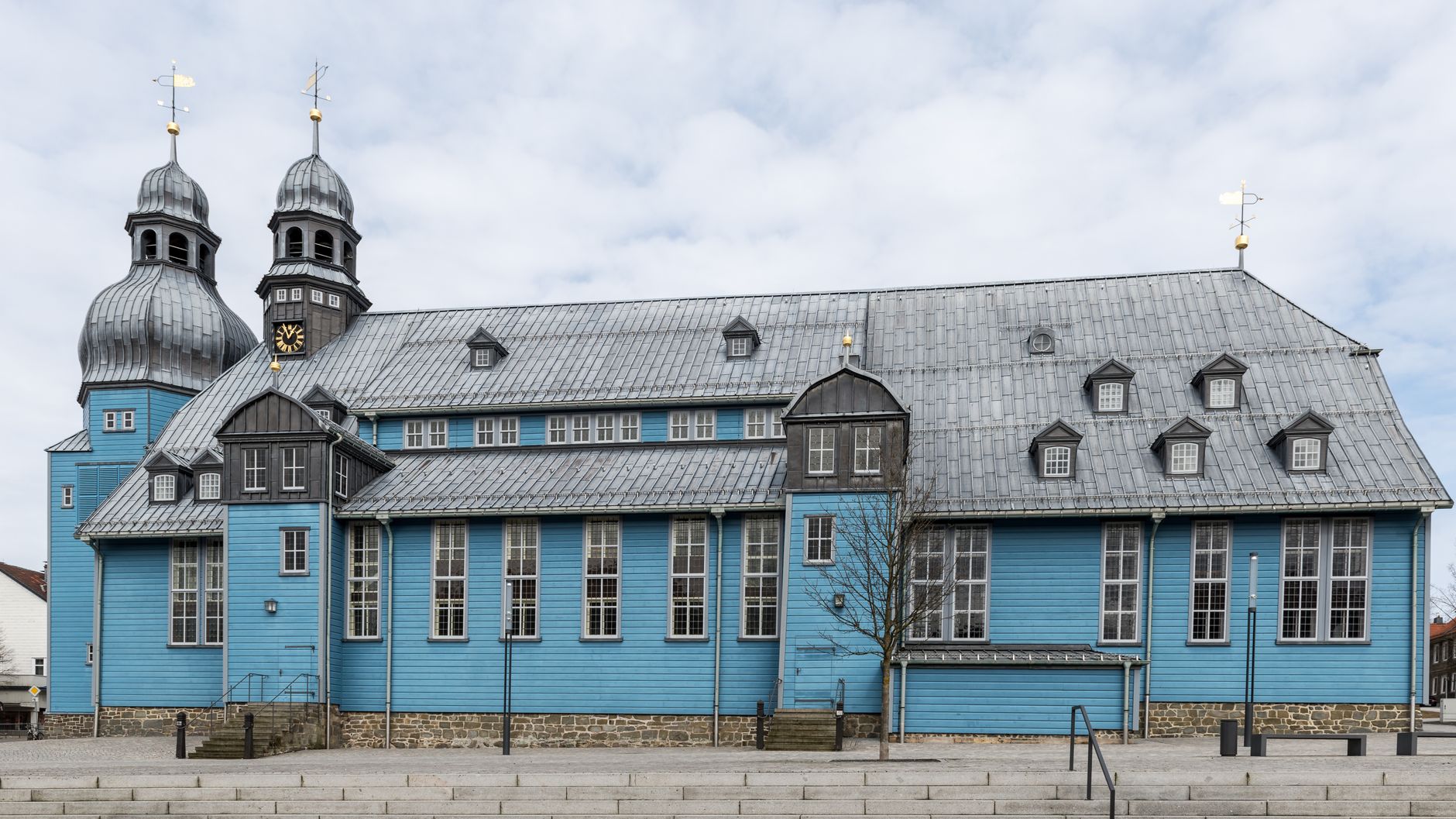
The largest wooden church in Germany sits at the centre of Clausthal-Zellerfeld, its whitewashed timber frame holding 2,200 seats — built between 1639 and 1642 for a town that once pulled silver from the surrounding hills around the clock. That mining past is everywhere here, from the steel headframe of the Ottiliae Shaft (the oldest still-standing headframe in Germany, 1876) to the 107 historic ponds laced across the plateau, all part of a UNESCO-listed water management system that once powered the mines.
Today the town runs at a quieter pace, its wide, tree-lined streets framing old burghers' and miners' houses around a generous market square. Clausthal University of Technology keeps things from going too still, and the trails — for hiking, Nordic walking, mountain biking — thread out in every direction.
💛 What travellers fall for
People who come back tend to do it in different seasons on purpose: summer for the trails and the mountain lakes, winter for the snow-covered streets and cross-country ski routes. The Upper Harz Mining Museum in the Zellerfeld district rewards a second visit once you've walked the landscape and can picture what the ponds and ditches were actually doing.
Deals in Clausthal-Zellerfeld
Book directly at the provider
How Clausthal-Zellerfeld came to be
Mining here goes back to the 12th century, when monks first worked the ore seams. The industry peaked across the 16th to 18th centuries, driving the construction of an extraordinary hydraulic infrastructure — over 310 kilometres of transport ditches and 107 ponds engineered across eight centuries to drain shafts and power machinery, now a UNESCO World Heritage site. The Clausthal Mint operated from 1617 to 1849; its final building (1726) survives as a student dormitory. In 1775, the mining academy that would become Clausthal University of Technology was founded to train the engineers the industry needed.
The twin towns of Clausthal and Zellerfeld merged officially in 1924, a decade before the mines finally closed in the 1930s. An air raid on 7 October 1944 destroyed the railway station and 70 other buildings. The Innerste Valley Railway, which had connected the town since 1877, ran until 1976.
Who and what shaped it
People who shaped it
Landmark buildings
See Clausthal-Zellerfeld in motion
Plan your visit
On the map
When to go
Summers are mild, with July highs around 20°C, and the plateau can be pleasantly cool when lower Germany is sticky. Winters bring reliable snow and temperatures that dip to around -4°C in January — the town looks the part, and cross-country ski trails open across Zellerfeld. Fog is common at altitude year-round; pack a layer whatever the season.
Right now
Background & history adapted from Wikipedia (CC BY-SA) · specs from Wikidata (CC0) · weather from Open-Meteo · map data © OpenStreetMap contributors · photos from Wikimedia Commons / Unsplash with per-image credit. No third-party reviews or social posts reproduced.