
Church of Santo Tomé

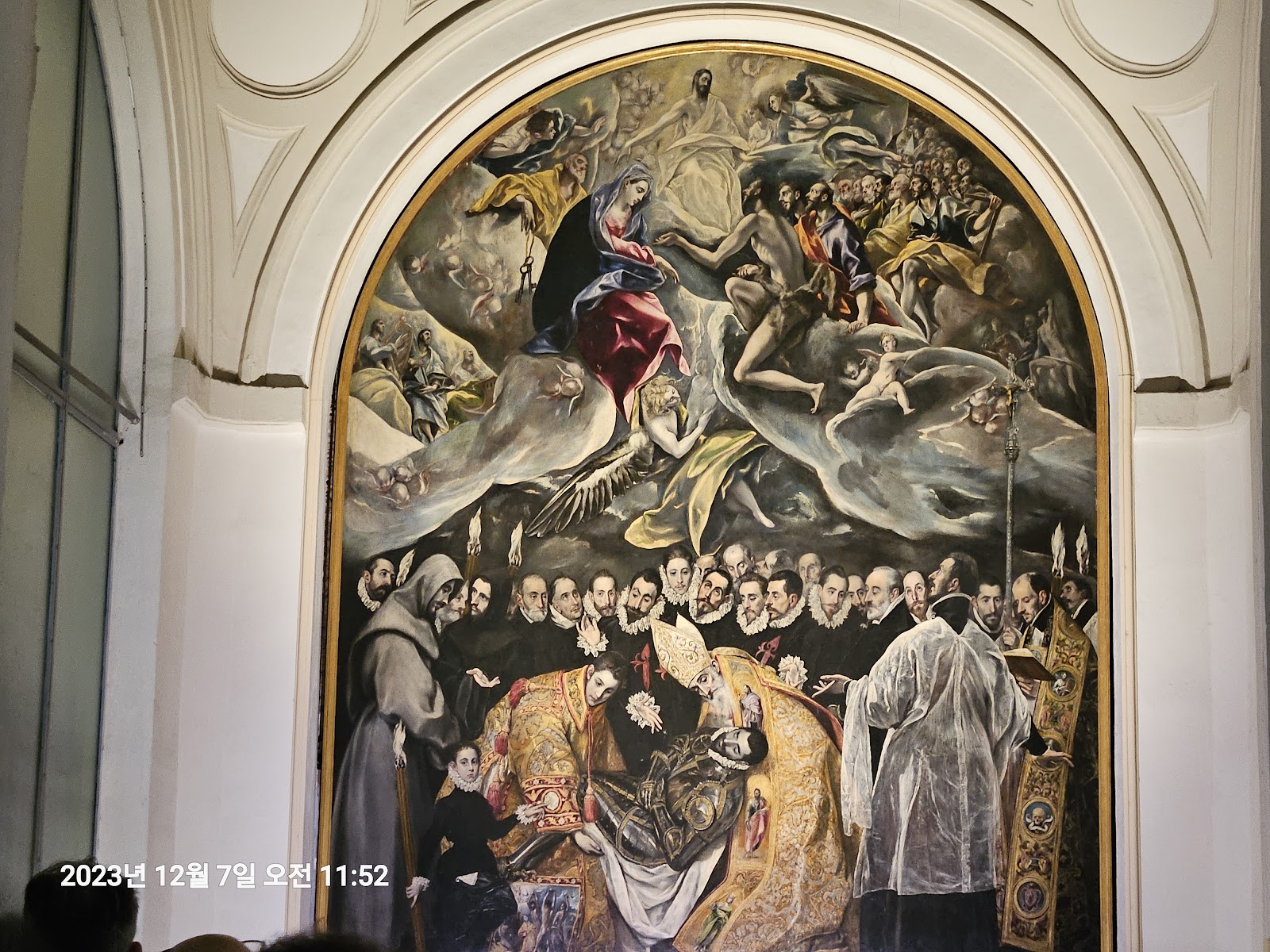
The church itself is modest — three naves, a Mudéjar bell tower that once served as a mosque minaret, a 14th-century sculpture of the Virgin with a faint, knowing smile. Most people come for one painting. El Greco finished *The Burial of the Count of Orgaz* sometime between late 1587 and spring 1588, and it has barely moved since: a 4.8 by 3.6 metre canvas filling the Chapel of the Conception, where it was always meant to hang.
The painting splits the world in two — a crowd of black-robed Toledans below, a swirl of saints and angels above — and the longer you stand with it, the more faces you find.

💛 What travellers fall for
People who come back tend to arrive right when the doors open at 10:00, before tour groups stack up in front of the canvas. Stand to the left side of the painting and look for the boy in the foreground pointing outward — thought to be El Greco's son — and the figure near him widely believed to be a self-portrait of the painter himself.
The story behind Church of Santo Tomé
The site has been in continuous religious use since before Toledo's Christian reconquest in 1085. Its first documented mention as a church comes from 1142, built over an 11th-century mosque whose minaret was kept standing and eventually converted into the Mudéjar bell tower you see today — two upper sections of brick, its windows framed by pointed horseshoe arches.
The church as it largely stands was rebuilt in the early 14th century by Gonzalo Ruiz de Toledo, Lord of Orgaz, who died in 1323 and left funds for its enlargement. It was Andrés Núñez, parish priest two and a half centuries later, who commissioned El Greco to paint a memorial to that same benefactor — the contract signed 18 March 1586.
Good to know
Entry is €4, or fold it into the €14 Toledo Monumental wristband covering seven sites. Open daily, with summer hours running to 18:45 and winter hours to 17:45. Allow at least 30 minutes. Photography without flash is permitted inside.
Where is Church of Santo Tomé?
More tickets & tours for Church of Santo Tomé
Book directly at the provider
What travellers say about Church of Santo Tomé
As Rick Steves states, everyone comes (and pays for) the famous painting. Otherwise, the church is nice, but not spectacular.
Stunning church that's needed to visit if you are in the area... Stunning art work in the main entrance to church. Included in the wristband for the town churches, so make sure you get
I visited the Iglesia de Santo Tomé in Toledo — such a beautiful old church! It’s famous for housing El Greco’s painting “The Burial of the Count of Orgaz.” The atmosphere inside is peaceful, and the art and stone architecture are just breathtaking. Definitely worth a visit if you love history or art.
For me, the attraction was to see the el Greco painting - much larger (est. 3 X 5m?) and more detailed than expected. It can be very crowded in the relatively small room and most tours only come for the painting. The chapel, while beautiful, is similar in design, details and icons to many others in Spain.
This is a must see painting. Advice leave enough time to visit the church, a beautiful contemplative space. The gift shop sells a wonderful postcard to remind you of your visit much better than photos on our phones.
More of Toledo
Discover where to stay, what to do and the best deals for your trip.
Explore Toledo →More attractions in Toledo
All of Toledo →


Background adapted from Wikipedia (CC BY-SA) · map data © OpenStreetMap contributors · ratings & place photos via Google · other photos with per-image credit. Ticket links may earn us a commission at no extra cost to you.