
Cathédrale Saint-Étienne de Toulouse
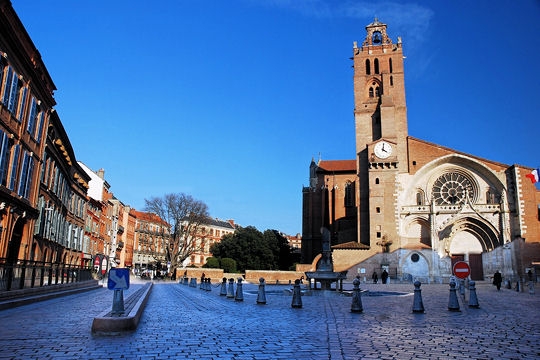
Saint-Étienne stops you before you even step inside. The west front is visibly unresolved — a Romanesque nave and a Gothic choir that never quite married, the axis of one misaligned with the other by several degrees. Architects argued about reconciling them for centuries and never did. What you get instead is one of the more honest buildings in France: a cathedral that shows its work.
Inside, the mismatch only deepens. The Gothic choir, begun in 1272 by master builder Jean Deschamps, is twice as wide as the nave it was meant to replace. The organ hangs at twenty metres like a swallow's nest. Pierre-Paul Riquet, who dug the Canal du Midi, is buried here.

💛 What travellers fall for
People who come back tend to find the stained glass first and the organ second. The oldest glass — late 13th century — sits in the Saint Vincent de Paul chapel, easy to walk past. The organ concerts, when they happen, are worth the modest fee; the acoustics in that mismatched space do something unexpected.
The story behind Cathédrale Saint-Étienne de Toulouse
The ground under Saint-Étienne has been sacred since at least the 3rd century, when a chapel associated with Saint Saturnin stood here. The first documented reference to a cathedral on the site appears in an 844 charter of Charles the Bald. Bishop Isarn began the Romanesque structure around 1078; his successor Amiel continued it. By the early 13th century, a new Gothic nave — single-volume, wide, designed to carry a preacher's voice — was built over the earlier remains.
Bishop Bertrand de l'Isle-Jourdain then commissioned Jean Deschamps to begin a new Gothic choir in 1272, conceived on a far grander scale than the nave. The two were never unified. Baroque redecoration followed a 1609 fire, carried out between 1667 and 1680 by architect Pierre Mercier and sculptor Gervais Drouet, whose marble retable depicting the stoning of Saint Stephen still dominates the east end. The cathedral has been a listed monument historique since 1862.

Good to know
Free to enter, open Monday–Saturday 8am–7pm, Sunday from 9am. The nearest metro stop is Esquirol on Line A, a five-minute walk southeast along Rue de Metz. Allow an hour if you want to take in the tapestries and chapels without rushing.
Where is Cathédrale Saint-Étienne de Toulouse?
More tickets & tours for Cathédrale Saint-Étienne de Toulouse
Book directly at the provider
What travellers say about Cathédrale Saint-Étienne de Toulouse
A straight, impressive church both from the outside and inside, with massive columns, numerous side chapels, and beautiful wooden decorative elements. It is wonderful to walk around the choir area and also admire the asymmetry of the building’s architecture from the outside. Highly recommended for everyone.
A wonderful cathedral with an interesting history and fascinating juxtaposition of architectural styles. There is some major renovation going on in the red brick section of the building, so it was not possible to visit this area. But the main cathedral is wonderful with its soaring ceilings and vaulted archestruly stunning.
Finding the correct entrance was a bit tricky (initially I thought they might be closed, and the sign on the door maps led me to supported that), but once inside it was nice. Wish I could have seen the whole cathedral, but a large section was closed off for restoration.
Currently under heavy renovation. The pretty much concealed replacement entrance is hard to find, one needs to pass through what looks like a private courtyard ... just to find the house of God closed during the official opening times. (Sunday, 09:30, it should already have been open for half an hour, see the photo attached.) Also a way to chase away potential visitors and make them lose interest...
A slightly more sparton than the other cathedrals in the city. Very interesting brick work. Places to sit outside as well.
More of Toulouse
Discover where to stay, what to do and the best deals for your trip.
Explore Toulouse →More attractions in Toulouse
All of Toulouse →
Background adapted from Wikipedia (CC BY-SA) · map data © OpenStreetMap contributors · ratings & place photos via Google · other photos with per-image credit. Ticket links may earn us a commission at no extra cost to you.