
Bradford


Bradford's skyline is punctuated by a 249-foot chimney that once drew smoke from one of the largest silk factories in the world. That chimney — belonging to Lister Mills, designed in the Italianate style in 1873 — still stands, and it tells you something essential about this city: the industrial ambition here was operatic in scale.
By the mid-19th century, Bradford was processing roughly two-thirds of Britain's wool and had earned the title of wool capital of the world. That era left behind a city of extraordinary Victorian architecture, a UNESCO World Heritage village in Saltaire, and a cultural confidence that earned Bradford the UK City of Culture title for 2025 — and, since 2009, the world's first UNESCO City of Film designation.
💛 What travellers fall for
People who keep coming back tend to arrive early at Salts Mill — the David Hockney gallery inside the old mill building draws crowds by midday. They'll also tell you to walk the Saltaire streets proper, not just the mill, and to give Bolling Hall more time than you think it needs. Bradford Interchange puts you in the city centre immediately; the Forster Square station is quieter if you're heading toward the cathedral quarter.
Experiences you don't want to miss


Deals in Bradford
Book directly at the provider


How Bradford came to be
A fulling mill recorded in 1311 marks Bradford's earliest documented involvement in wool, though settlement here goes back to Saxon times, centred on the streets around Kirkgate and Ivegate. The medieval town was modest — a Thursday market, a parish church on a site used since the 7th century — but the Industrial Revolution transformed it at extraordinary speed. By 1841 there were 38 worsted mills in the town alone; within a decade, Bradford had a population of 100,000 and was the undisputed centre of global wool production.
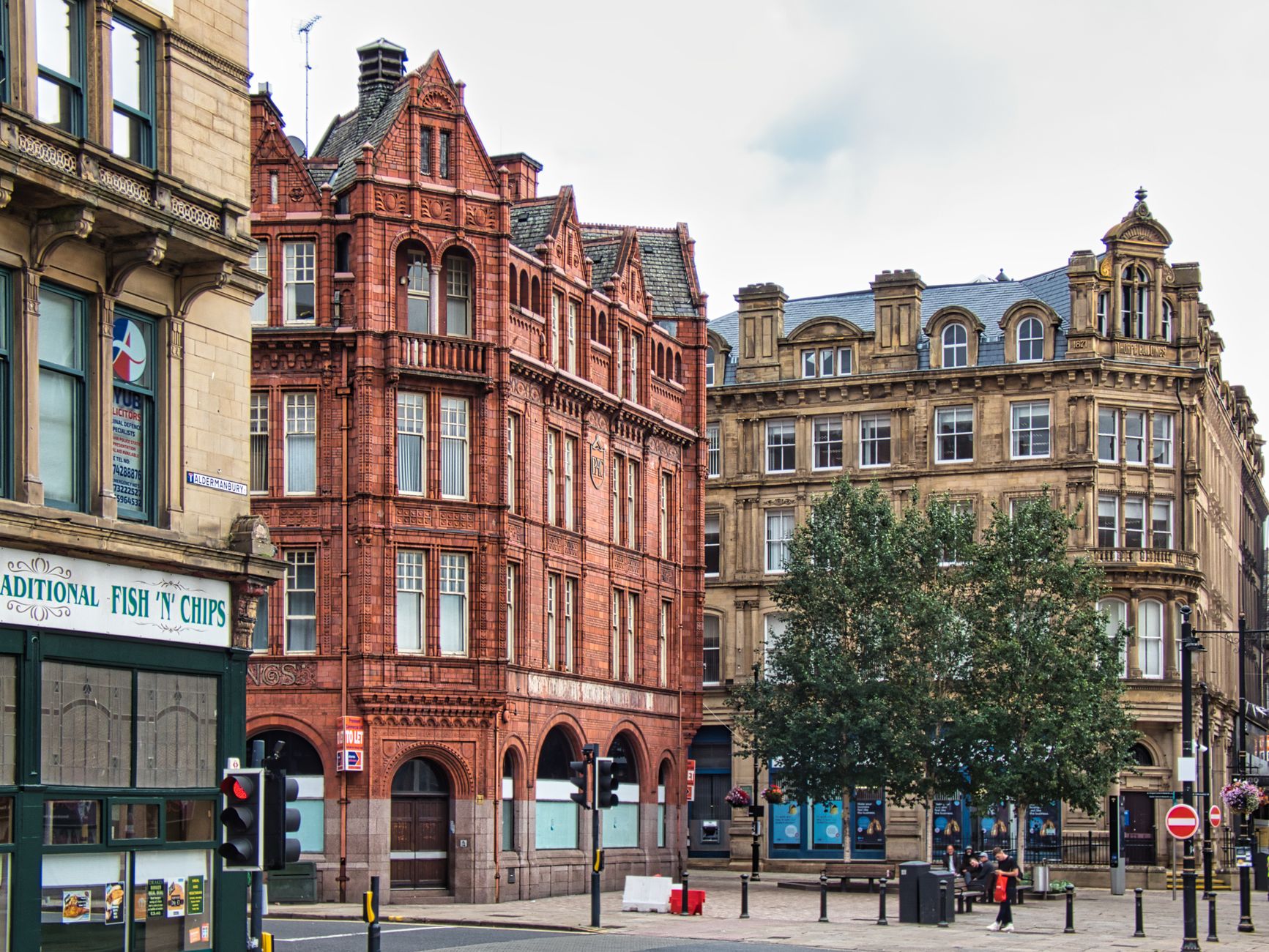
The wealth generated in those decades is still visible in stone. City Hall, opened in 1873 to designs by local architects Mawson and Lockwood, features a bell tower standing 220 feet high, modelled on the Palazzo Vecchio in Florence. Nearby, the Wool Exchange speaks in Venetian-Gothic. Titus Salt's model village of Saltaire, built from 1853 onward in classical Italian Renaissance style, eventually joined the UNESCO World Heritage List. Bradford became a municipal borough in 1847 and received its city charter in 1897.
Who and what shaped it
People who shaped it
Landmark buildings
See Bradford in motion
Plan your visit
On the map
When to go
Bradford sits on the eastern edge of the Pennines and catches its weather accordingly — winters are damp and often grey, summers mild rather than warm, with rain possible in any season. April through September gives you the longest days and the best odds of dry spells for walking between landmarks.
Right now
Background & history adapted from Wikipedia (CC BY-SA) · specs from Wikidata (CC0) · weather from Open-Meteo · map data © OpenStreetMap contributors · photos from Wikimedia Commons / Unsplash with per-image credit. No third-party reviews or social posts reproduced.