
Blaenau Ffestiniog
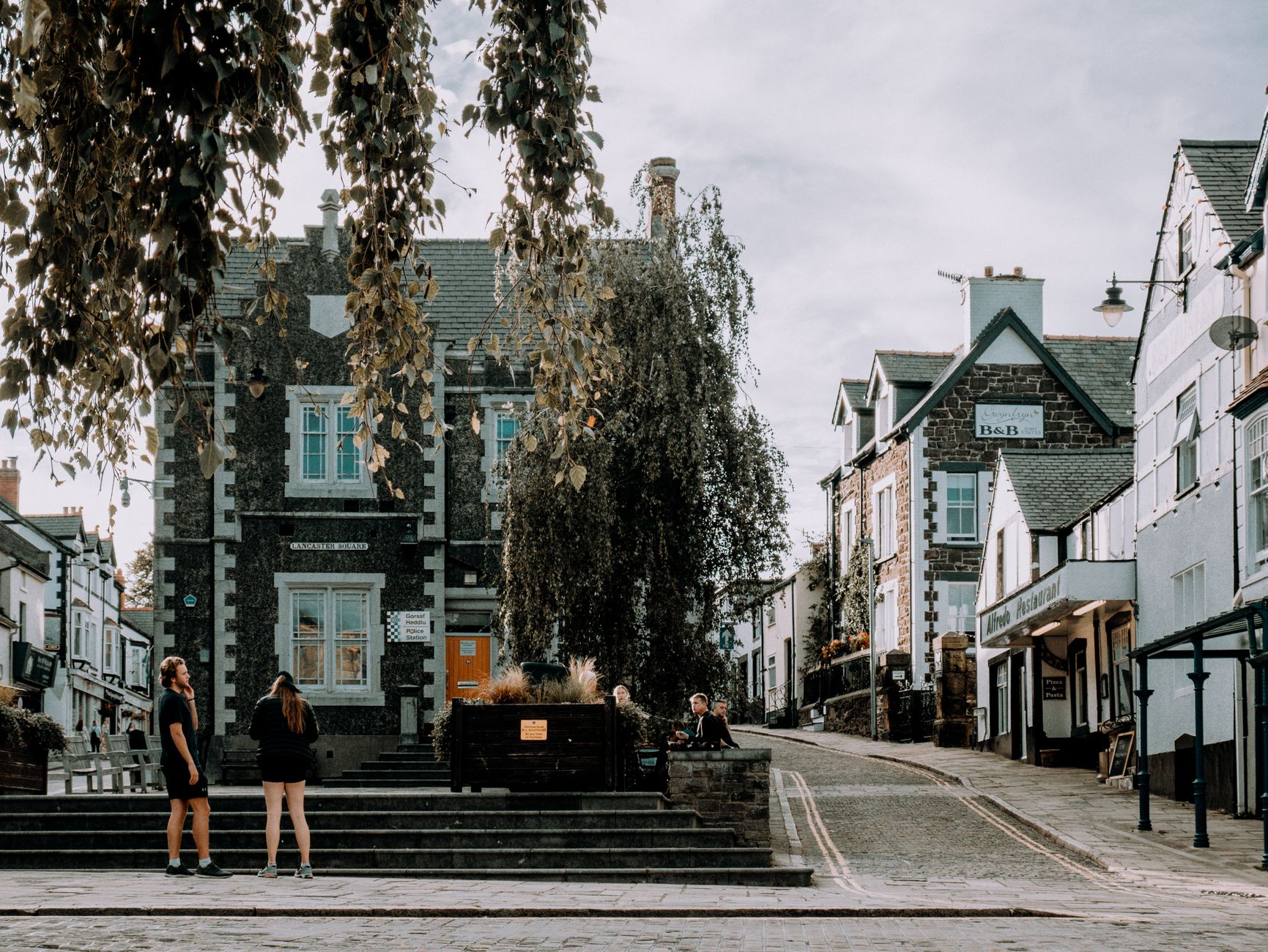



The slate is everywhere in Blaenau Ffestiniog — in the walls, the rooftops, the rubble heaps that rise behind the terraced streets like grey waves frozen mid-break. This is a town that was pulled out of a mountain, and it still looks the part. At its peak the population touched 12,000; now it sits closer to 4,000, and the space left by that departure gives the place a particular kind of weight.
What draws people here is partly the scale of what remains: the caverns at Llechwedd go deep into the hillside, the narrow-gauge railway still runs its 13½ miles down to Porthmadog, and the Old Market Hall on the high street carries the ambitions of a boomtown in every stone of its 1861 facade.
💛 What travellers fall for
People who come back tend to time it around the Ffestiniog Railway — arriving by the Conwy Valley Line from Llandudno Junction and leaving on the narrow-gauge steam service down to Porthmadog, so the town becomes a hinge between two journeys rather than a detour. Pack a waterproof regardless of the forecast.
Experiences you don't want to miss


Deals in Blaenau Ffestiniog
Book directly at the provider


How Blaenau Ffestiniog came to be
Before the quarries there were farms. The first systematic slate workings began in 1765 when partners from Cilgwyn took a lease on Gelli Farm and started cutting into Ceunant y Diphwys. By 1800, William Turner and William Casson had arrived from the Lake District and expanded operations. The town that grew to serve those mines went from 3,460 people in 1851 to over 11,000 by 1881 — one of the steeper population curves in Welsh industrial history.
In 1878, W. E. Oakeley amalgamated the workings into Oakeley Quarry, at that point the largest underground slate mine in the world. The Ffestiniog Railway, founded by Act of Parliament in 1832, carried the slate down to Porthmadog until it closed in 1946. A group of enthusiasts restored the line and reopened it in 1954; it now holds the distinction of being the oldest independent railway on earth.
Who and what shaped it
People who shaped it
Landmark buildings
See Blaenau Ffestiniog in motion
Plan your visit
On the map
When to go
Blaenau Ffestiniog is genuinely wet — annual rainfall averages around 1,421 mm, and even the driest month, April, brings nearly 100 mm. June through September is the most comfortable window, with temperatures reaching 17–19°C, though rain is possible any week of the year. Winter visits are raw and grey, which suits the landscape but demands proper kit.
Right now
Background & history adapted from Wikipedia (CC BY-SA) · specs from Wikidata (CC0) · weather from Open-Meteo · map data © OpenStreetMap contributors · photos from Wikimedia Commons / Unsplash with per-image credit. No third-party reviews or social posts reproduced.