
Basilique Notre-Dame de Fourvière
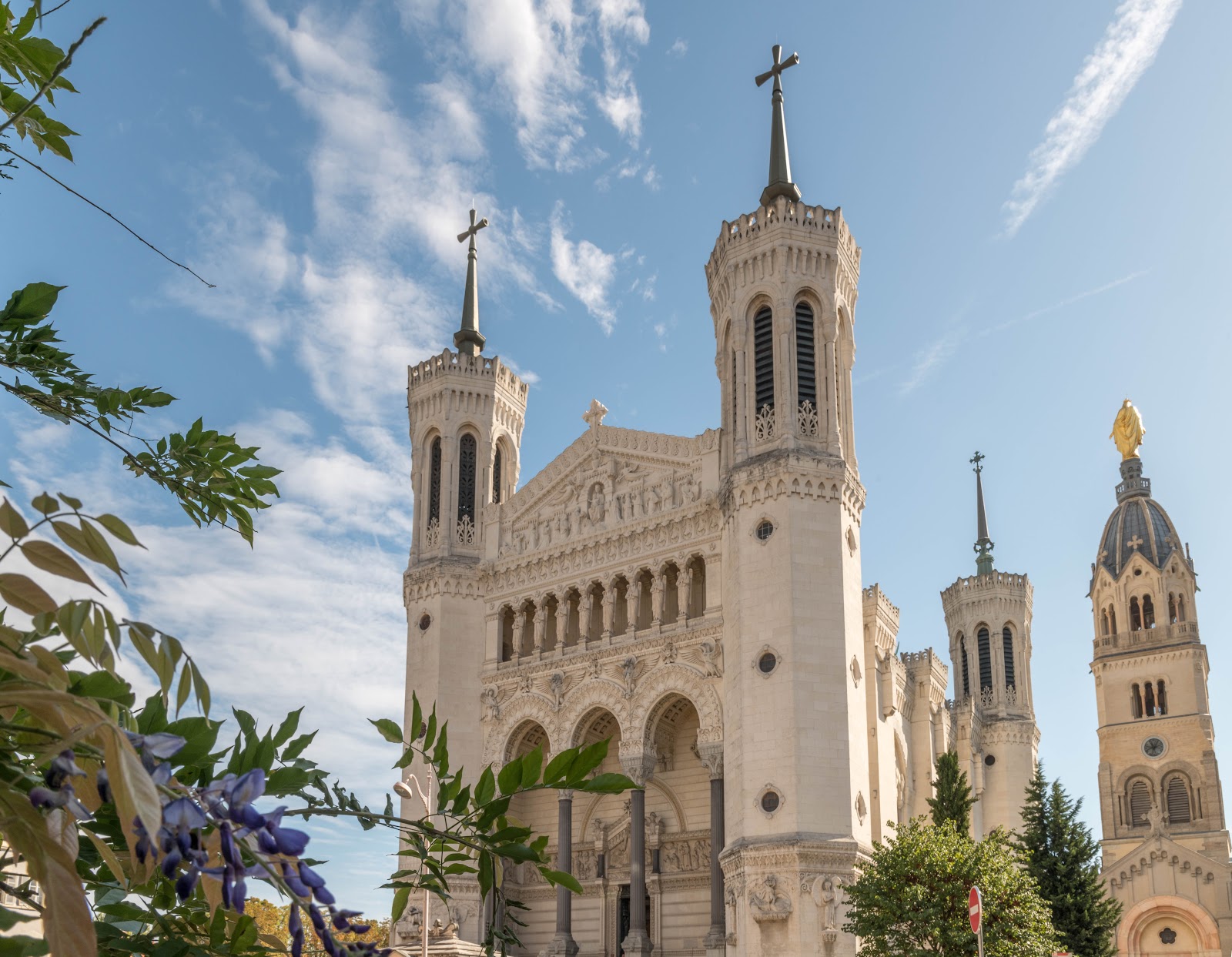
The golden statue of the Virgin Mary at the top of Fourvière's bell tower catches the light long before you reach the hill — a fixed point above Lyon's rooftops that the city has looked to for centuries. Up close, the basilica is harder to categorise than it first appears: Pierre Bossan drew from Byzantine, Romanesque and Gothic forms simultaneously, and the result is something singular, heavy with marble and mosaic, built not to a style but to a vow.
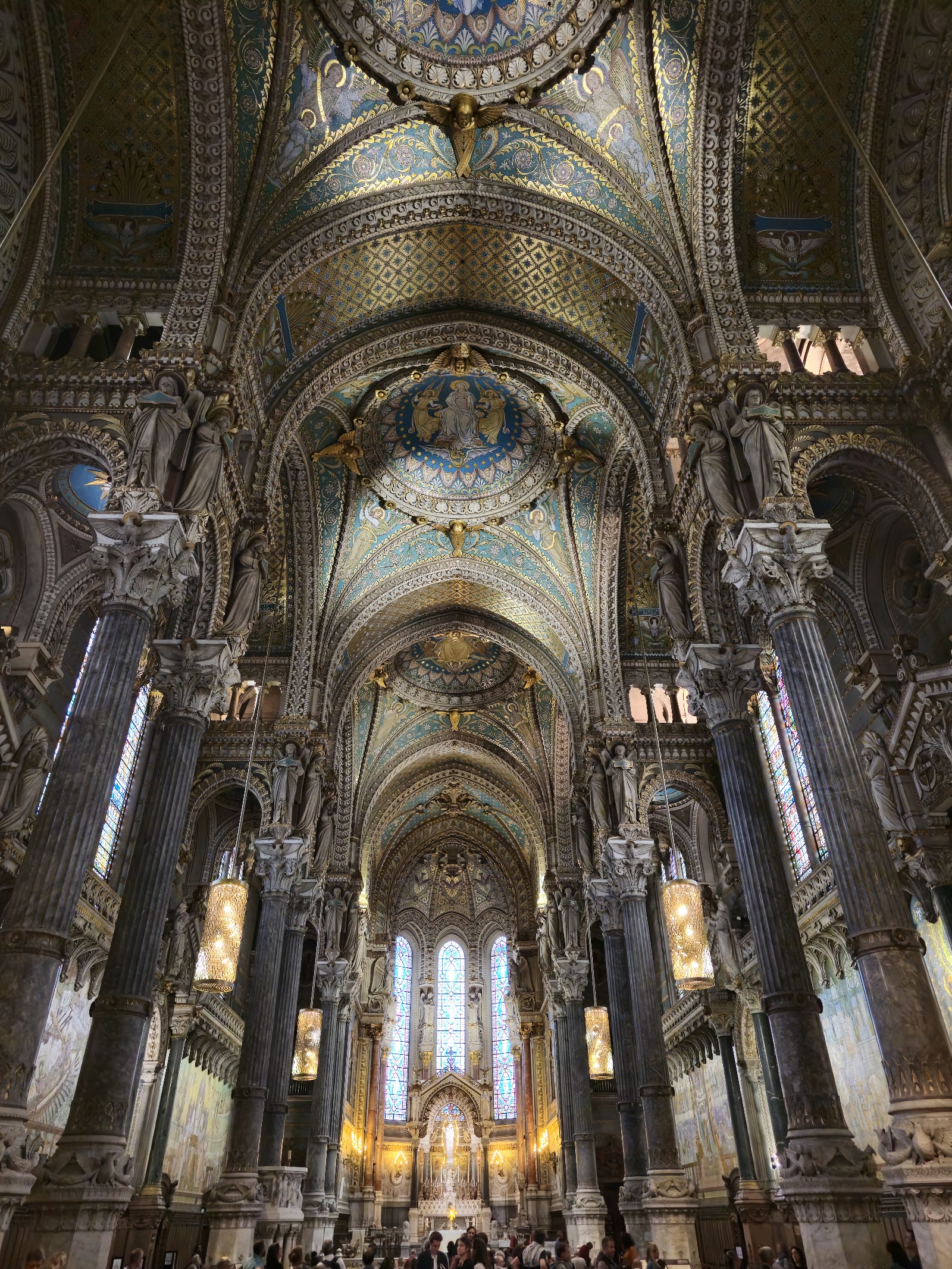
That vow dates to 1870, when Lyon's community pledged to raise this church if the city was spared the Prussian advance. Construction ran from 1872 to 1896, funded entirely by private donation, and the interior — in Carrara white marble, pink granite, blue Savoy marble and green onyx — kept being added to well past the Second World War.
💛 What travellers fall for
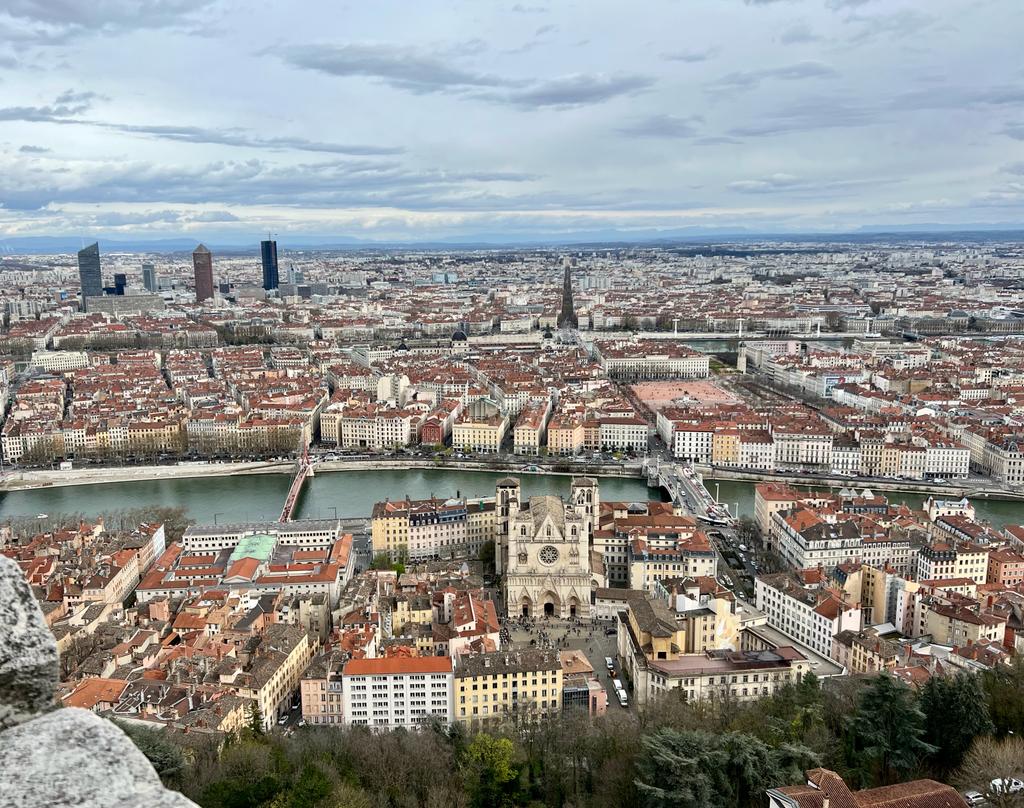
People who come back tend to book the rooftop tour (€7, through the Lyon Tourist Office) rather than treating the esplanade view as the whole story. The North Tower's 180-degree panorama, with Mont Blanc on a clear day, is a different experience entirely. The crypt, dedicated to Saint Joseph, is quieter than the upper church and worth the few extra minutes.
The story behind Basilique Notre-Dame de Fourvière
A shrine to the Virgin Mary has stood on this hill since 1170, on ground that was once the Roman forum of Trajan — fourvière is itself a corruption of forum vetus, old forum. The site accumulated significance across centuries: the Virgin was credited with Lyon's survival of plague in 1643, cholera in 1832, and the threatened Prussian occupation in 1870. That last deliverance prompted a formal commitment to build the present basilica.
The first stone went in on 8 November 1872, sunk 22 metres into the hillside. Architect Pierre Bossan, who died in 1888 before the work was done, designed the crypt as a deliberate threshold — pilgrims pass through the darkness of Saint Joseph's crypt before ascending into the light of the main church. Louis Sainte-Marie-Perrin saw the project through to its consecration in 1896; Pope Leo XIII erected it as a basilica the following year.
Good to know
Take funicular F2 from Vieux Lyon metro station — it drops you almost at the door in under five minutes. The upper church and crypt are free; budget 90 minutes for a self-guided visit or up to three hours with a guided tour. Book the rooftop tour in advance if that's your plan.
Where is Basilique Notre-Dame de Fourvière?
More tickets & tours for Basilique Notre-Dame de Fourvière
Book directly at the provider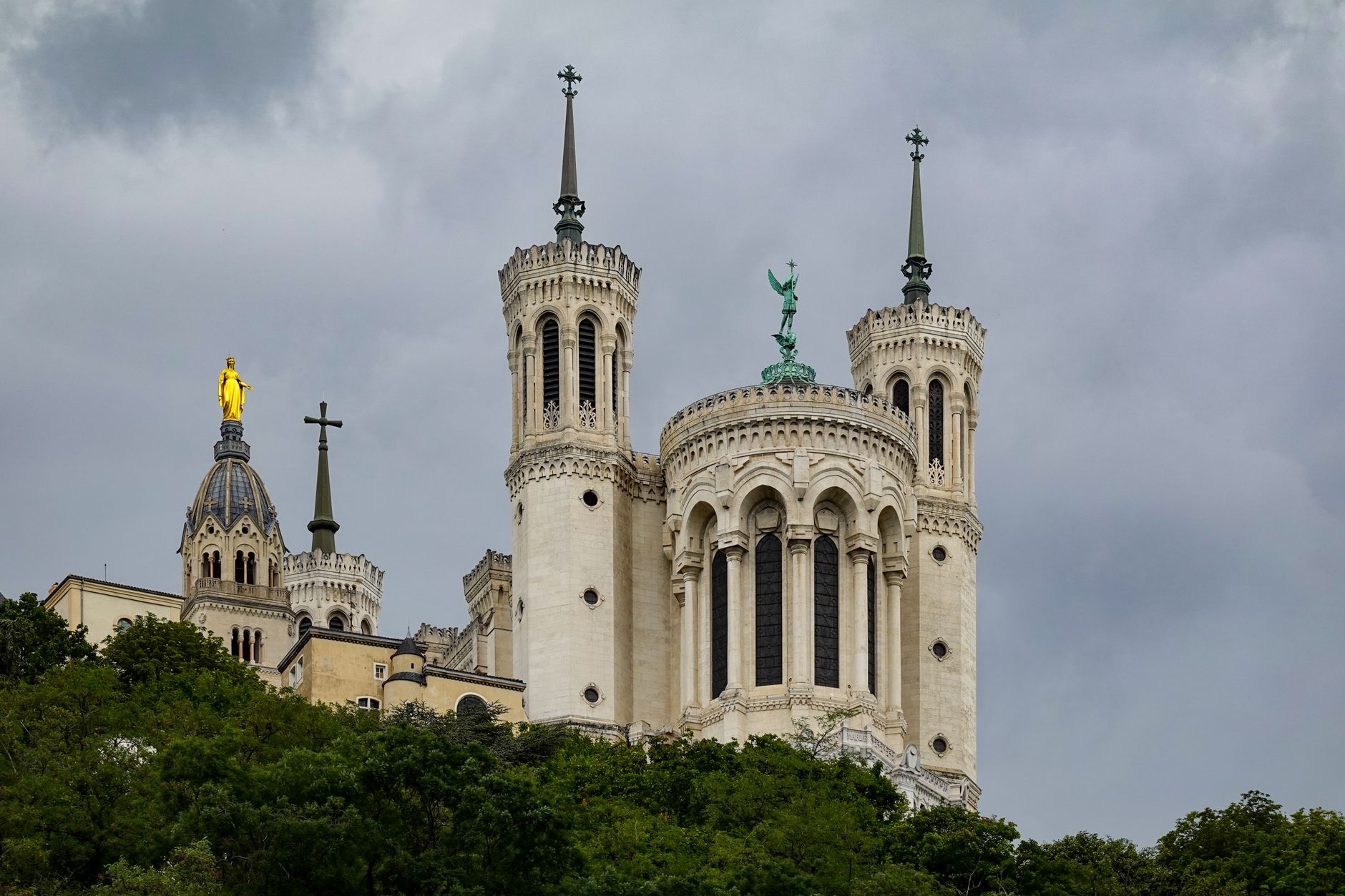
What travellers say about Basilique Notre-Dame de Fourvière
A beautiful, picturesque, and important place for both city residents and visitors. Lyon's answer to Notre Dame in Paris and Marseille. It offers a magnificent view of the entire city, especially at night. You can also take the funicular up there, which is also a local landmark. Unfortunately, the cathedral is still undergoing restoration, so not all its beautiful sides are visible.
Basilique Notre-Dame de Fourvière is a major landmark in Lyon located on Fourvière Hill, offering one of the best panoramic viewpoints over the city. It is a Roman Catholic basilica known for its distinctive architectural style, combining Byzantine and Romanesque influences, with highly detailed mosaics and interior decoration. The site is accessible via funicular from Vieux Lyon or by walking uphill, and the journey itself adds to the overall experience. The basilica is well-maintained, and the surrounding esplanade provides expansive views over the Saône and Rhône rivers, as well as key city landmarks. Inside, the structure is richly decorated with mosaics, stained glass, and ornate detailing, making it significantly more elaborate than typical churches in France. It is both a religious site and a major tourist attraction. Overall, the basilica is one of Lyon’s most iconic points of interest, combining architectural significance with exceptional city views.
The Basilica of Notre-Dame de Fourvière is, without question, one of the most breathtaking religious monuments in all of Europe. Perched high atop Fourvière Hill, it presides over the city of Lyon like a celestial guardian — its white stone façade gleaming in the sunlight, its ornate towers and turrets rising dramatically against the sky. From the esplanade in front of the basilica, the panoramic view stretching across Lyon is simply awe-inspiring: the confluence of the Saône and Rhône rivers, the terracotta rooftops of Vieux-Lyon, and on a clear day, the distant peaks of the Alps shimmering on the horizon. It is the kind of view that stops you in your tracks and makes the climb — or the funicular ride — entirely worthwhile. The basilica itself is a masterpiece of 19th-century architecture, completed in 1896 and lavishly decorated with mosaics, marble, and gilded stonework. Every surface tells a story — biblical scenes, the history of Lyon, and tributes to the Virgin Mary rendered in painstaking detail. The interior is luminous and grand, the kind of sacred space that instills a sense of wonder regardless of one’s faith. But perhaps the most surprising revelation awaits those who venture beneath the main church. Hidden below the basilica is an enormous crypt — a fully realized underground church of its own, comparable in size to what would serve as the primary place of worship in most towns and neighborhoods. Far from being a dim, austere space, the crypt is richly adorned, with its own chapels, altars, and artwork. It has an intimate, contemplative atmosphere quite different from the grandeur above, yet equally impressive in its own quiet way. For many visitors, discovering this subterranean sanctuary is the unexpected highlight of the entire experience — a hidden world beneath a world, each one magnificent in its own right.
The Basilica of Notre-Dame de Fourvière took my breath away. It is absolutely stunning - the most beautiful basilica I have ever seen. Stepping inside felt like entering a dream. The atmosphere was so peaceful, despite the number of visitors. Every surface is covered in intricate mosaics, colorful stained glass, gilded details, and elaborate artwork. No matter where you look, there is something beautiful to admire. Photos simply cannot capture the scale, craftsmanship, and atmosphere of this incredible place. We took the easy way up via the historic funicular, which was a fun experience for the kids and definitely saved our knees from the steep climb. The short ride up the hill is part of the experience and offers a unique way to reach one of Lyon’s most iconic landmarks. Admission to the basilica is free, making it an easy addition to any Lyon itinerary. Once at the top, the panoramic views are spectacular. From the terrace, you can look out over Vieux Lyon, the winding Saône and Rhône rivers, the city skyline, and miles beyond. It’s also a short stroll to the ancient theatre. It’s the perfect place to pause, take photos, and appreciate just how beautiful Lyon is from above. It’s also a short stroll to the ancient theatre.
What a spectacular Basilica both inside and out. You must go inside to see one of the best interiors Ive ever seen. There is also a crypt well worth visiting. Spectacular views from either side outside the Basilica overlooking Lyon. There are cafes etc available outside again with great views. You can travel by various means but for fun it is a joy to ride on the funicular situated at the metro station. The hop on hop off bus stops very close or stay on board and it will take you outside the Basilica. If you are visiting Lyon this should be the top of your list to visit and it's free to enter.
More of Lyon
Discover where to stay, what to do and the best deals for your trip.
Explore Lyon →More attractions in Lyon
All of Lyon →
Background adapted from Wikipedia (CC BY-SA) · map data © OpenStreetMap contributors · ratings & place photos via Google · other photos with per-image credit. Ticket links may earn us a commission at no extra cost to you.