
Abbey Church of Saint Michael
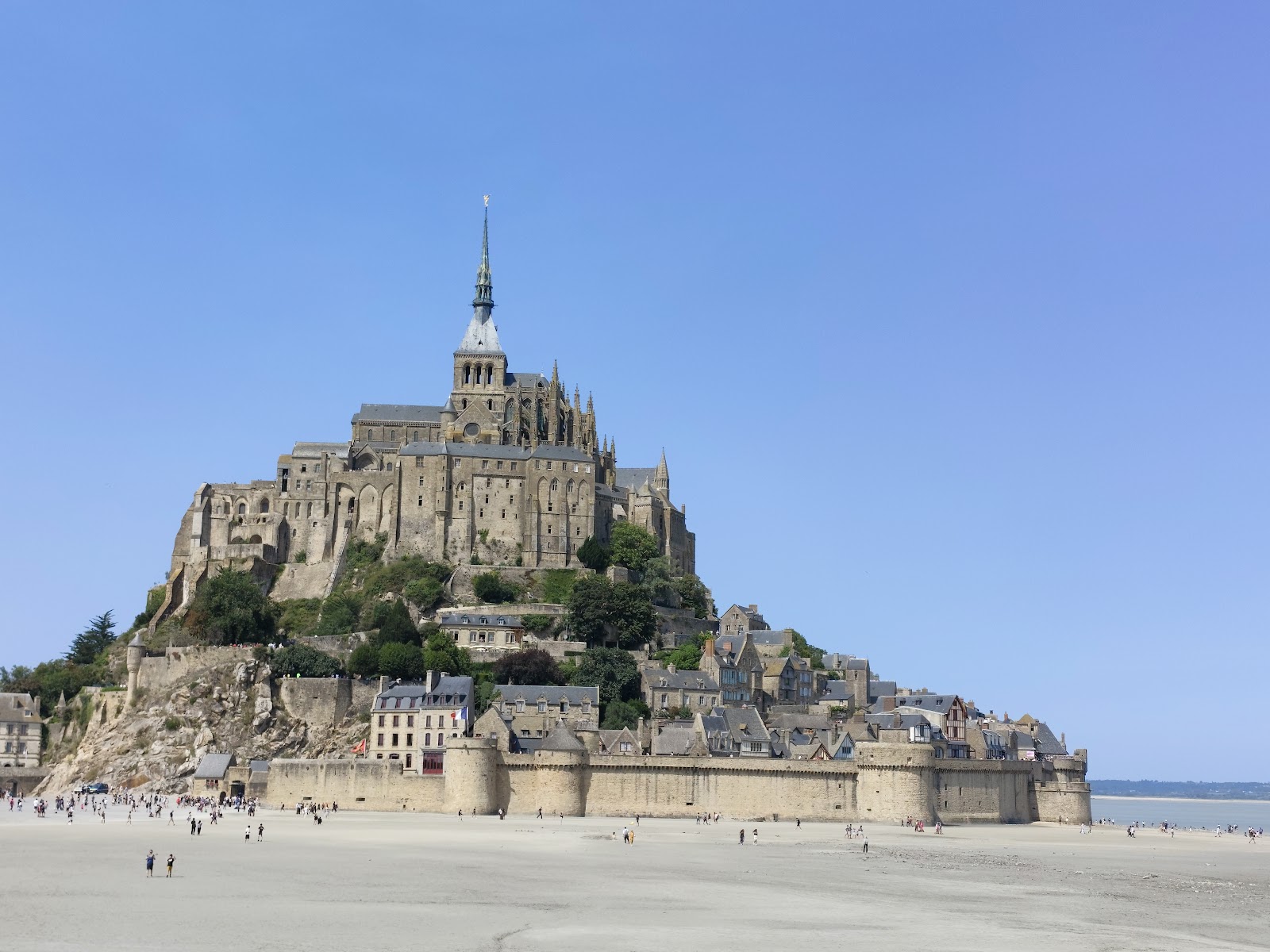
At the very summit of the rock, above the Grande Rue and the ramparts and everything else that crowds the lower slopes, the Abbey Church of Saint Michael stands where the archangel reportedly told Bishop Aubert, three times over, to build. The first sanctuary was consecrated on 16 October 709, and the site has been accumulating stone and story ever since.
What you notice at the top is the quiet authority of the place — Romanesque nave giving way to a flamboyant Gothic choir rebuilt after the original collapsed in 1421, and above it all a gilded copper statue of the archangel himself, 4.5 metres tall, 520 kilograms, perched 156 metres above the bay and doubling as a lightning rod.

💛 What travellers fall for
People who come back tend to time their visit for opening hour, when the abbey is emptiest and the low light crosses the nave at a useful angle. The Grand Degré — the inner staircase of 90 steps — rewards those who take it slowly enough to look at the walls rather than the feet ahead of them.
The story behind Abbey Church of Saint Michael
The founding legend traces to 708, when the Archangel Michael appeared to Aubert, Bishop of Avranches, and instructed him to raise a sanctuary on the tidal rock then called Mont-Tombe. Duke Richard I of Normandy installed Benedictine monks here in 966, and construction of the Romanesque abbey church began around 1023. The Italian architect William de Volpiano was brought in by Richard II to build the church from 1060. Abbot Robert de Torigni — advisor to Henry II of England — reinforced the structure and built the main facade in the 1100s.
The Hundred Years War left its mark: the Romanesque choir collapsed in 1421 and took a century to rebuild in flamboyant Gothic. The Revolution closed the abbey in 1791 and turned it into a prison; by the time that closed in 1863, the building was in serious disrepair. Architect Édouard Corroyer spent two years persuading the government to classify it as a historic monument, which happened in 1874, then devoted fifteen years to its restoration. Benedictine monks returned in 1969; the Monastic Fraternities of Jerusalem have held the community since 2001.

Good to know
Entry is €11 for adults; under-18s are free. Allow 1.5–2 hours inside. Last entry is one hour before closing; audioguides cut off 30 minutes earlier. Factor in up to an hour's walk from the car park, 2.5 km away. Closed 1 January, 1 May, and 25 December.
Where is Abbey Church of Saint Michael?
Location
- In Mont Saint-Michel
- 48.6364, -1.5118
- Open in Google Maps
Rating
4.7 ★ · 15,094 Google reviews
More tickets & tours for Abbey Church of Saint Michael
Book directly at the provider
What travellers say about Abbey Church of Saint Michael
Amazing place. Just so busy, very crowded, however well organised. It's good idea to walk there and take the free bus back. You need hour or so to walk around the village ( walking round the village is free).
Mont Saint-Michel is amazing! Views from the fields are stunning. Arrive early at the abbey to avoid crowds. Shuttles run frequently, which is handy. Parking cost €20 for 5 hours. A small tip: eat outside the castle for better value. We had an interesting trip and highly recommend visiting here!
Highly recommend the audio tour. It was very interesting and gave great information you would not know just by walking through. Extremely busy place. We also dod the extra museums there and enjoyed them.
This is a place you have to see! There is a lot of steps here to climb but well worth it. Shops sideline the main entrance and there is always something to see. Toilets are just inside to the left and further up to the right. They are somewhat few and far between so use them as needed. The crowds are terrible as when groups, bus tours, school tours are in there. There, one must have patience. Weather can be unpredictable so take appropriate clothing as it is, and can be windy out there. Once parked, you can grab a shuttle which will take you closer, otherwise it can be a bit of a walk. Caution is to be taken as there is quicksand in the area when the tide is out, if you venture out that way. I think that you are required to have a guide if you go out there and it would be strongly suggested.
I visited Mont-Saint-Michel Abbey alone, which I had long wanted to do. It was truly wonderful and inspiring. The biggest issue in my life is my own death and the death of a loved one, which I will experience someday. I wanted to deepen my consideration about it, so I visited Mont-Saint-Michel Abbey and prayed silently. As I walked around the Abbey, I thought about this issue. Although I have not found an "answer" about this issue, the experience of praying at Mont-Saint-Michel Abbey gently enveloped me. This experience is a treasure of my life. I will never forget it. May God bless all the people of the world!
More of Mont Saint-Michel
Discover where to stay, what to do and the best deals for your trip.
Explore Mont Saint-Michel →More attractions in Mont Saint-Michel
All of Mont Saint-Michel →
Background adapted from Wikipedia (CC BY-SA) · map data © OpenStreetMap contributors · ratings & place photos via Google · other photos with per-image credit. Ticket links may earn us a commission at no extra cost to you.