
Region

Saxony

City break Culture & history luxury

Saxony is where Germany's Baroque ambitions met their most extravagant expression. The Golden Rider statue of Augustus the Strong still stands at a Dresden crossroads, every square millimetre gilded, three years after his death — a ruler so committed to spectacle he converted to Catholicism just to become King of Poland. That particular energy — grand gestures, serious craft, unlikely combinations — runs through the whole region.

Beyond Dresden, which has its own page here, Saxony rewards slower movement: the porcelain town of Meissen, the Renaissance courtyards of Torgau, the Art Nouveau streets of Chemnitz's Kassberg quarter, and a landscape of river valleys and forested uplands that shaped the politics of the Reformation.

Good to know
Leipzig and Dresden have international rail connections and airports. A car earns its keep for reaching Augustusburg, Moritzburg, and the smaller castle towns. Spring and early autumn are the most comfortable seasons for moving between sites. Allow at least four days to reach beyond Dresden.
The story

How Saxony came to be

The duchy that would become Saxony traces back to the early eighth century, when it emerged as a Carolingian stem duchy covering much of northern Germany. In 919, Duke Henry of Saxony was elected German king, founding the Ottonian dynasty. The territory fragmented in 1180, but in 1423 the name and the electorate passed to Frederick I of the Wettin family, and the Wettins would shape the region for centuries.

Albert established Dresden as capital in 1485. Then came Augustus the Strong, who from 1697 drew Europe's finest musicians, architects and painters to his court, turning Dresden into a continental showcase. Napoleon made Saxony a kingdom in 1806; the Congress of Vienna cut it down. Reunification in 1990 restored it as a free state with Dresden once again at its centre.

People & landmarks

Who and what shaped it

People who shaped it

Augustus the Strong
Elector of Saxony and King of Poland; brought Europe's finest musicians, architects, and painters to Dresden from 1697, establishing it as a leading cultural centre.
Henry of Saxony
Elected German king in 919, founding the Saxon (Ottonian) dynasty.
Martin Luther
Protected by Saxon Elector Frederick III; founded the Protestant movement in Germany.
Daniel Libeskind
Modified the Bundeswehr Military History Museum in Dresden by inserting a wedge through the historical arsenal building.
Hans Scharoun
Architect of Schminke House in Löbau, one of four most important residential buildings of classical modernism in the world.
Henry van de Velde
Belgian architect and designer; designed Villa Esche Art Nouveau villa in Chemnitz, 1902–1903, extended 1911.

Landmark buildings

Dresden Frauenkirche
18th-century Baroque Evangelical Lutheran church; destroyed in WWII, rebuilt 1994–2005; defining landmark of Dresden's Neumarkt square.
Zwinger Palace
One of Germany's most famous Baroque buildings, built during the reign of Frederick Augustus I and II; includes multiple palaces and castles.
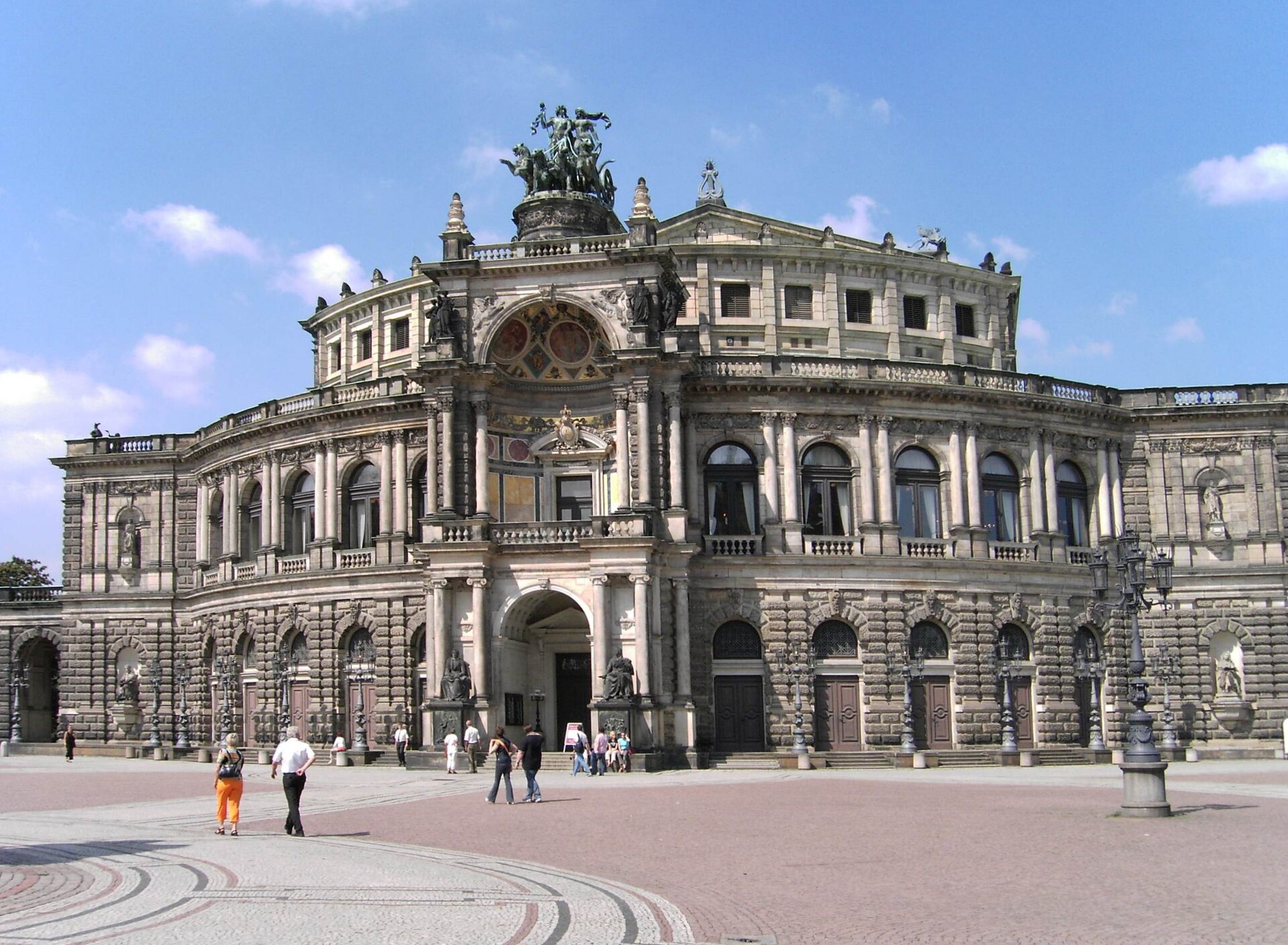
Semper Opera House
Originally completed 1841; rebuilt 1878 following a fire in 1869.
Katholische Hofkirche
Catholic Cathedral of Holy Trinity designed by Roman architect Gaetano Chiaveri; one of Dresden's most exuberant Baroque buildings, reconstructed mid-1980s.
Albrechtsburg Castle, Meissen
Late Gothic architectural monument; Germany's first castle built solely as a residence.
Augustusburg Palace
Hunting and pleasure lodge of Augustus the Strong; one of Central Europe's most beautiful Renaissance palaces.
Moritzburg Castle
Hunting lodge that took its present form in the 18th century under Augustus the Strong.
Schloss Pillnitz
Built by Augustus the Strong as a royal retreat; combines Far Eastern architectural styles with traditional Baroque influences.
Hartenfels Castle, Torgau
Renaissance architectural masterpiece closely connected to the history of the Protestant Reformation.
Old Town Hall, Leipzig
Considered one of Germany's most important secular buildings of the Renaissance.
Schminke House, Löbau
Factory owner's mansion by architect Hans Scharoun; one of four most important residential buildings of classical modernism in the world.
Villa Esche, Chemnitz
Art Nouveau villa designed by Henry van de Velde, 1902–1903, extended 1911.
Kassberg Quarter, Chemnitz
One of Europe's largest and most beautifully restored Art Nouveau districts.
Hellerau Garden City, Dresden
Founded 1909; Festival House built 1911 in reform architecture style, considered a major work of 20th-century architecture.
Procession of Princes, Dresden
335-foot-long world's largest porcelain art installation; 23,000 porcelain tiles depicting 800 years of the Wettin dynasty with 35 rulers.
Golden Rider Statue, Dresden
Statue of Augustus the Strong completed 1736, three years after his death; entirely covered in gold leaf.
Practical

Plan your visit

On the map

When to go

Saxony has a continental climate: cold winters with snow in the uplands, warm summers that can push into the low thirties. Spring and September offer mild temperatures and manageable crowds at the major palace sites.

Right now

19°C
Partly cloudy
Sat
25°
17°
Sun
🌦️
20°
13°
Mon
18°
11°
Tue
🌧️
22°
12°
Weather data: Open-Meteo

Background & history adapted from Wikipedia (CC BY-SA) · specs from Wikidata (CC0) · weather from Open-Meteo · map data © OpenStreetMap contributors · photos from Wikimedia Commons / Unsplash with per-image credit. No third-party reviews or social posts reproduced.

Top