
Olomouc
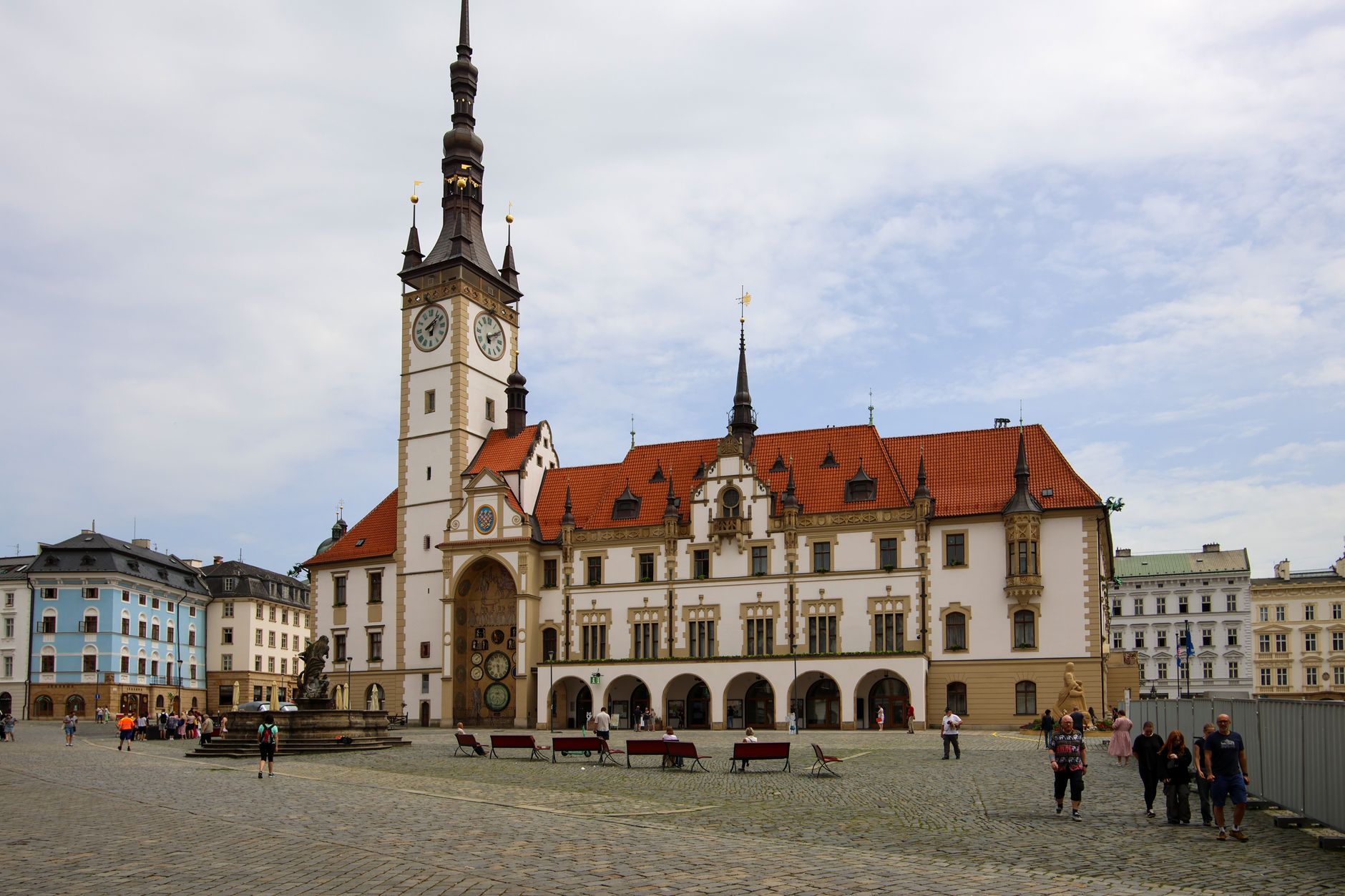
The first thing you notice in Olomouc is the scale of the Upper Square relative to the city around it — a wide cobbled space that feels borrowed from somewhere twice the size. At its centre, a 35-metre Baroque column dedicated to the Holy Trinity took nearly four decades to build and drew Empress Maria Theresa to its 1754 consecration. Six mythological fountains punctuate the surrounding streets, and the astronomical clock on the town hall facade tells the time in a style shaped by postwar socialist aesthetics — an odd, compelling face on a mechanism that dates to the early 15th century.
Olomouc is Moravia's second city but carries the quiet confidence of a university town that has been producing scholars since 1573. Palacký University keeps the streets lively with students, the cafés well-used, and the cultural calendar full year-round.
💛 What travellers fall for
People who come back tend to time a visit around the Saturday farmers' market on the Lower Square, walk up to Svatý Kopeček for the pilgrimage basilica and the view over the plain, and spend longer than planned inside St. Wenceslas Cathedral — specifically the Romanesque crypt, which the crowds that linger on the square rarely find.
How Olomouc came to be
Slavic settlers were here by the 9th century, drawn to a ford on the Morava River and the defensible hill above it. A bishopric followed in 1063, royal city status in 1253, and in 1314 King John of Luxemburg formally named Olomouc capital of the Margraviate of Moravia. The city flourished under Matthias Corvinus in the 15th century — the Gothic Church of St. Maurice dates to this period — and acquired a university in 1573.
The Thirty Years' War ended that ascendancy: Swedish occupation in 1641 cost Olomouc its capital status to Brno, and it never fully recovered politically. Yet it remained a seat of intellectual life. In 1746, the first learned society in the Habsburg lands convened at what is now Petráš Palace. A century later, in 1848, Emperor Ferdinand I signed his abdication at the Archbishop's Palace in favour of Franz Joseph — a quiet room in which the shape of an empire changed.
Who and what shaped it
People who shaped it
Landmark buildings
See Olomouc in motion
Plan your visit
On the map
When to go
Summers are warm and dry, making June through August the most comfortable time to walk the squares and fountains. Winters are cold and occasionally snowy, which suits the Baroque architecture well but demands layers; spring and autumn offer mild temperatures and far thinner crowds.
Right now
Background & history adapted from Wikipedia (CC BY-SA) · specs from Wikidata (CC0) · weather from Open-Meteo · map data © OpenStreetMap contributors · photos from Wikimedia Commons / Unsplash with per-image credit. No third-party reviews or social posts reproduced.