
Hameau de la Reine
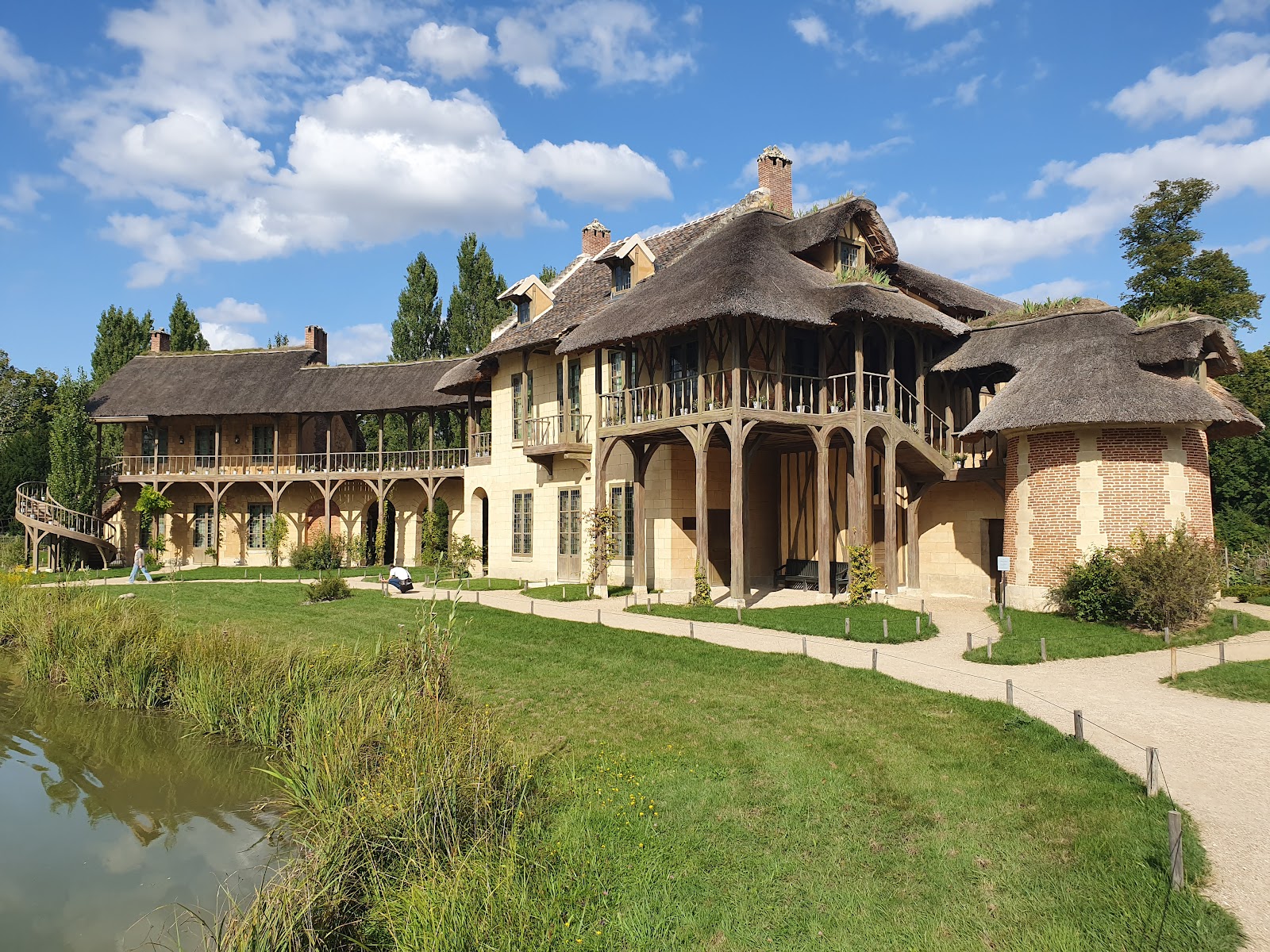
Twelve thatched cottages arranged around a small lake, a working mill that never once ground grain, a tower built for signalling the palace half a kilometre away — the Hameau de la Reine is less a village than a stage set that gradually reveals its own logic. Built between 1783 and 1786 for Marie Antoinette at the far edge of the Trianon gardens, it was a place she actually used: fishing from the Marlborough Tower, tasting dairy in her dedicated tasting room, receiving guests in a barn that doubled as a ballroom.
The hamlet sits 800 metres beyond the Petit Trianon, far enough from the palace that the silence feels earned. Five of the twelve buildings were reserved for the queen; the other seven ran as a functioning farm, complete with a farmer — Valy Bussard, who arrived from Touraine on 14 June 1785 — and a Swiss guard whose house had a secret passageway so he could patrol without being seen.

💛 What travellers fall for
People who come back tend to arrive right at noon when the gates open, before the guided-tour groups form at Petit Trianon. Walk directly to the Marlborough Tower and look back across the lake — the proportions of the whole hamlet read best from there. The Boudoir, at just 4.6 by 5.2 metres, is easy to miss; it's worth finding.
The story behind Hameau de la Reine
Richard Mique, Marie Antoinette's preferred architect, designed the hamlet with compositional input from the painter Hubert Robert, taking inspiration from the Prince of Condé's earlier Hameau de Chantilly (1774–75). Construction ran from 1783 to 1786. After the Revolution the buildings were abandoned and fell into serious disrepair — the barn and the preparation dairy were eventually demolished during the First Empire as beyond saving. Napoleon I began restoring what remained in 1810 and gave the hamlet to his second wife, Empress Marie-Louise.
A major restoration in the 1930s was funded by John D. Rockefeller Jr. The farm buildings were fully rebuilt in the early 2000s and reopened in 2006 with live animals. The entire Versailles estate, including the Hameau, has been a UNESCO World Heritage Site since 1979.

Good to know
Entry is via the Trianon ticket (€12), or bundled into the day or two-day Pass. The Hameau opens at noon in low season, 10 am in high season; closed Mondays. Interiors are guided-tour only (1h30, departing from Petit Trianon). Free for under-18s and EU residents under 26.
Spring and early autumn offer the clearest light and the most readable reflections on the lake. Summer brings crowds but also the full green of the surrounding gardens; the walk from Petit Trianon can feel long in July heat. In winter the hamlet has a spare, almost melancholy quality that suits it well — opening hours shorten, but the site is rarely crowded.
Where is Hameau de la Reine?
More tickets & tours for Hameau de la Reine
Book directly at the provider
What travellers say about Hameau de la Reine
Le Petit Trianon was the refuge from the court of Vesailles for Marie Antoinette. It was gifted to her by her husband, Louis XVI in 1774. We entered Le Petit Trianon and straight away followed the outdoor path to the Temple of Love. We contined on to the Queens Hamlet; a wonderful walkable and lovely stroll that takes you back to another time. There are rustic cottages that guests of the Queen stayed in upon her invite. Herbs and vegetables were grown in the gardens that were used for meals. It also included a dairy. There are waterways and unique and prized trees planted throughout. We spent more than half of the afternoon exploring this vast area, so we had run out of time to go inside Le Petit Trianon! Its only opened from 10am-5:30pm, so it would be best to plan ahead according to what you want to see. We enjoyed this more than dealing with the crowds at Versailles. Take the little train one or both ways, ( stops at the grand canal, and Le Grand and Petit Trianon) which was 9 euros when we visited in Feb 2026. Be sure to find out beforehand when the last little train leaves, as we missed it. Its about a 30 minute walk back to the Palace from Le Petit Trianon.
Officially the cutest place on earth. Not to be missed. If you had to choose, I would skip the main palace with its reproductions and bad art, that you won't be able to see anyway because of the crowds.
If you walk a couple of miles from the Palace of Versailles, you reach the hamlet that Marie Antoinette had built to amuse herself and her guests. It’s like a Disney village. Totally bonkers, but my favourite part of the Versailles estate.
I think my favorite part of Versailles was this country hamlet built for the queen's peace of mind. See the photos. A relatively long (35 minute one way) walk, but I was also at peace here.
Beautiful and way better than the main chateau. I want to gatekeep because the lack of crowds made for a really peaceful experience.
More of Versailles
Discover where to stay, what to do and the best deals for your trip.
Explore Versailles →More attractions in Versailles
All of Versailles →
Background adapted from Wikipedia (CC BY-SA) · map data © OpenStreetMap contributors · ratings & place photos via Google · other photos with per-image credit. Ticket links may earn us a commission at no extra cost to you.