




An extraordinary temple-mountain that’s a must-see in Angkor Thom. The picturesque long causeway leading from the Terrace of the Elephants is unlike anything here. There are steep stairs on the left side to take you to the top, and stairs on the top right side to descend. Stunning reliefs grace the various upper levels and temple’s back gate. There is a memorial marker on the first level at the back in honor of Pascal Royere, the dedicated French architect and monument restoration specialist responsible for Baphoun’s reconstruction. In 2011, Mr. Royere was awarded the Légion d’honneur, France’s highest decoration, for his work with the EFEO at Angkor. He dedicated 18 years of his life making sure Baphuon was done. Cambodia and the Apsara Authority honored his life, twice, upon his death in 2014.
Angkor Thom
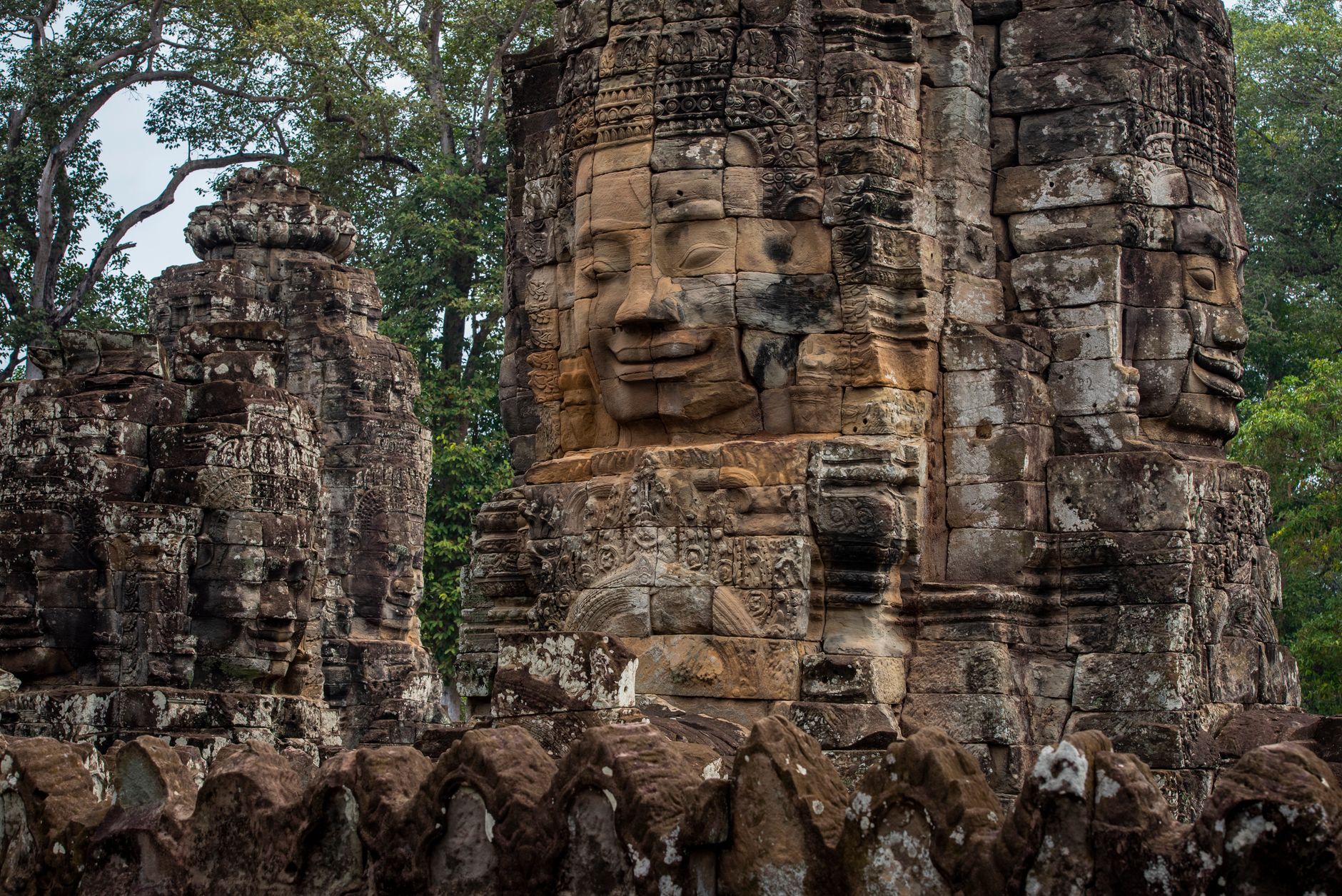
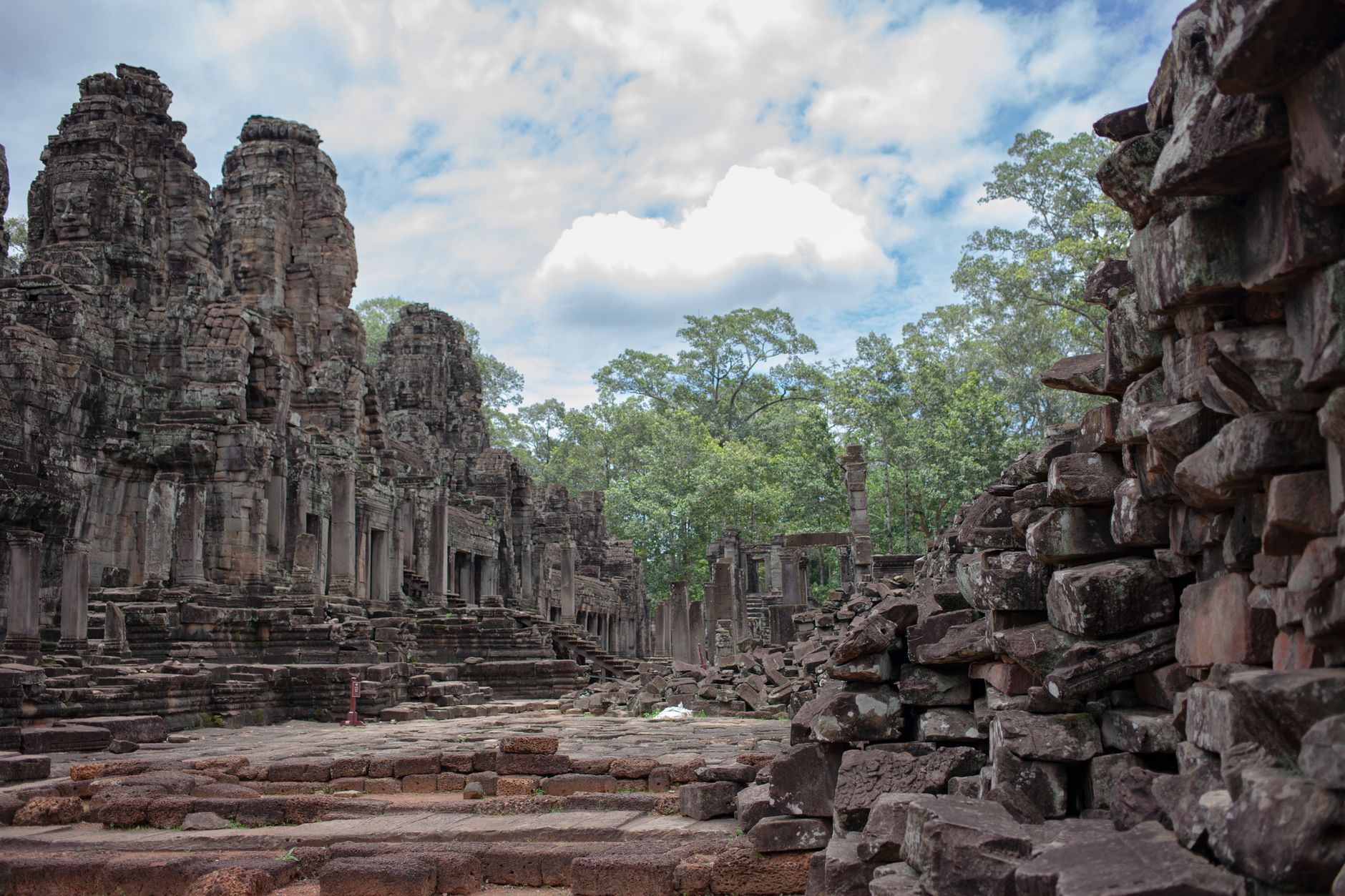
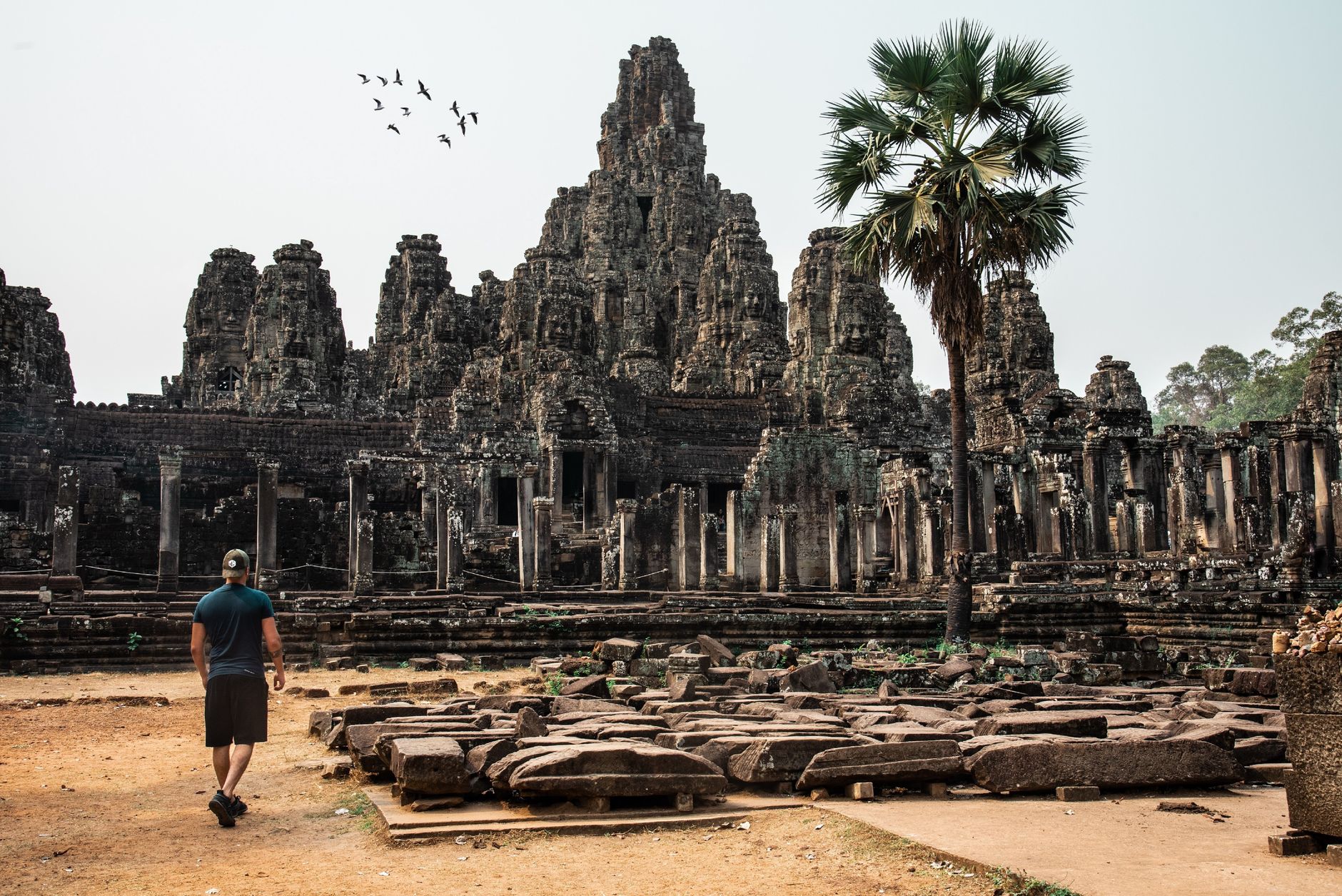
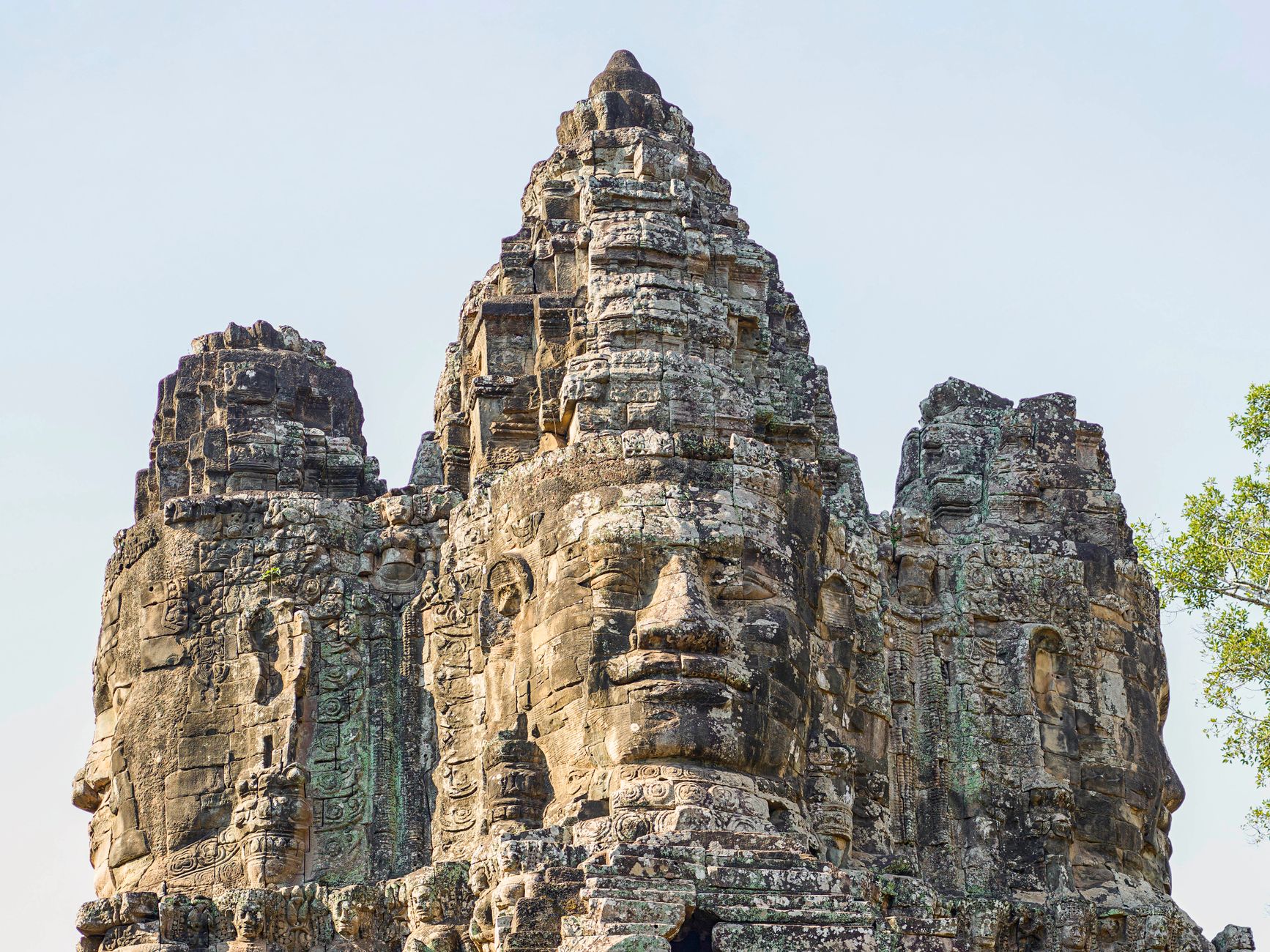
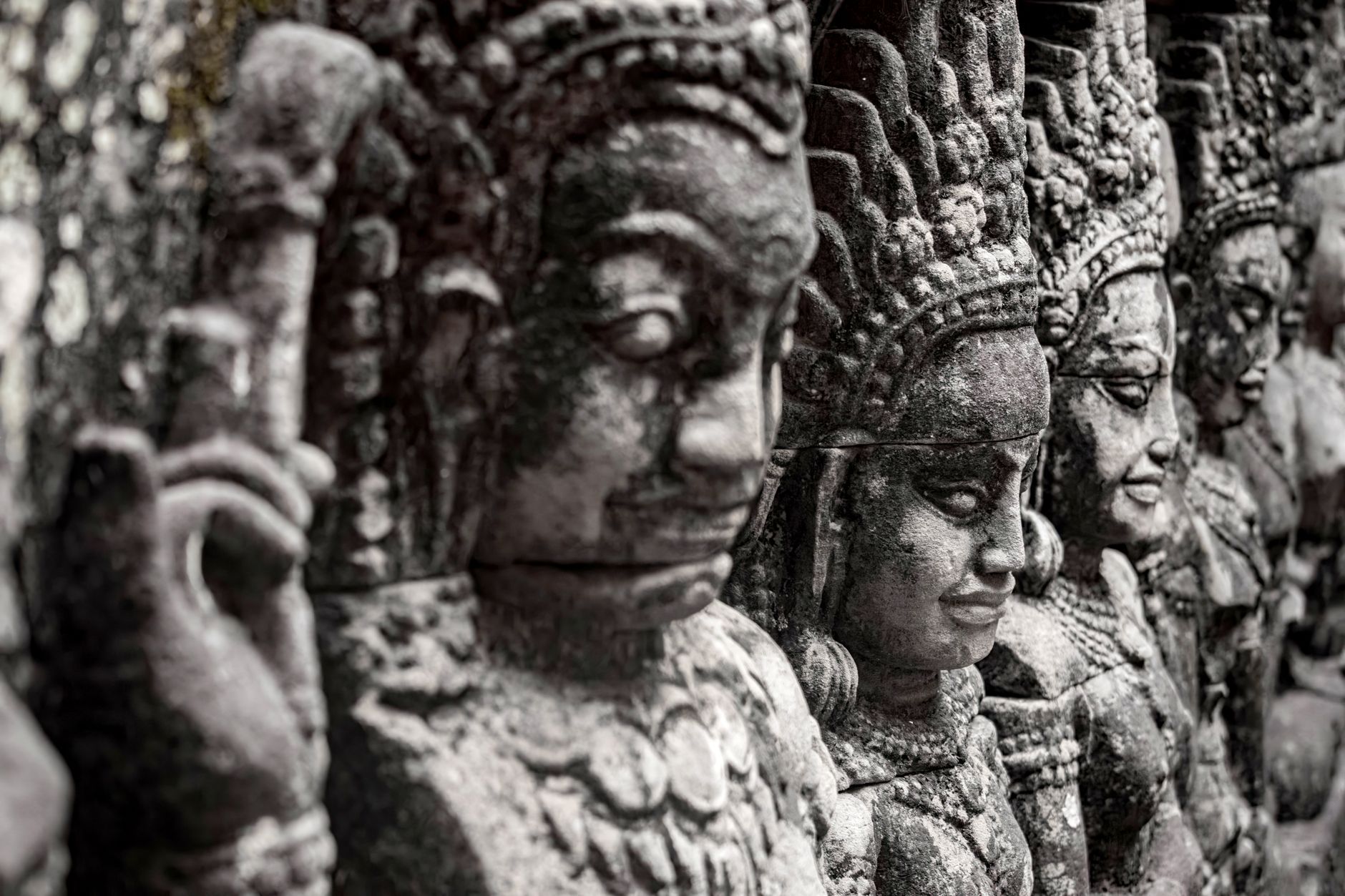
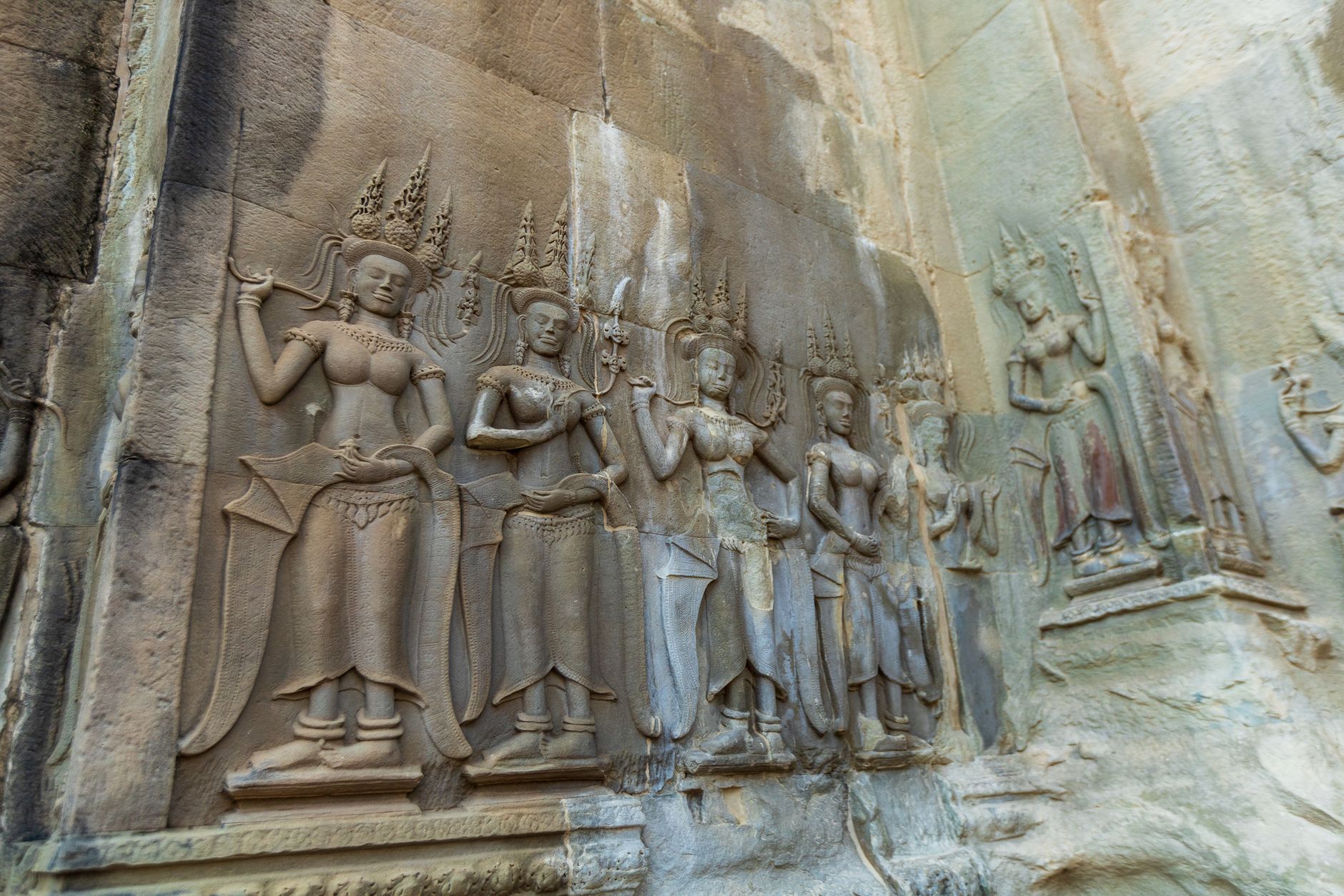
The first thing you notice at Angkor Thom is the gate. A 23-metre sandstone tower rises from the causeway, and carved into each of its four faces is a giant, serene, half-smiling visage — the same face that will follow you through the entire city. Cross the moat, pass beneath it, and you are inside something that once held perhaps a hundred thousand people within walls three kilometres to a side.
Built around 1200 CE by King Jayavarman VII, Angkor Thom was the final and most ambitious capital of the Khmer empire. What remains today — temples, terraces, causeways, the great moat — occupies roughly 900 hectares and represents the concentrated ambition of one of history's most prolific royal builders.
💛 What travellers fall for
People who come back tend to skip the South Gate on return visits and enter instead through the East or North — fewer tuk-tuks, better light on the stone faces. They also linger on the inner wall of the Terrace of the Elephants rather than the outer face, where a second tier of carvings runs almost unseen at knee height.
Experiences you don't want to miss
Deals in Angkor Thom
Book directly at the providerHow Angkor Thom came to be
The ground beneath Angkor Thom had already been royal territory for centuries before Jayavarman VII arrived. Phimeanakas, a Hindu temple with a golden tower, was raised here by Rajendravarman in the 10th century; the Baphuon, a 50-metre pyramid temple, followed under Udayadityavarman II in the 11th. These structures predate the city walls entirely and stand today as monuments to the dynasties Jayavarman inherited.
Jayavarman VII came to power in 1181 after the Cham people had sacked the previous capital. His response was to build on a scale the empire had never seen — Angkor Thom, with its moat, its five gated causeways, its Bayon at the centre, took shape around 1200. The last temple constructed within the walls, Mangalartha, was dedicated in 1295. By 1609, when the first Western visitor recorded his impressions, the city was already empty.
Who and what shaped it
People who shaped it
Landmark buildings
See Angkor Thom in motion
Plan your visit
On the map
When to go
The dry season, November through April, brings cooler mornings and manageable heat by mid-afternoon — the most comfortable window for walking the site. The wet season, May through October, turns the surrounding forest deep green and thins the crowds, but expect heavy afternoon downpours and high humidity.
Right now
What travellers say about Angkor Thom
Baphuon is a short walk north from the Bayan, along the large roads that connect the city of Angkor Thom. Small monkeys wander the roads and sit among the trees, comfortable with their human visitors. We reach the temple and I can see why it is called a mountain. It's no Everest, but even to get to the first level visitors will need to climb a decent number of stairs. Before doing so I decided to take a walk around the base of the temple to see how it looked from below. There are many smaller buildings surrounding the mountain, most of them consisting of only the doorframes and small segments of the walls. Piles of cut stone lay around the site, parts of the buildings that haven't been restored to their original locations. This tower was one of the most ruined of those discovered in the area, and restoration efforts made this place known as the "largest 3D jigsaw puzzle in the world." I felt a sense of loss that we will never again see it how it once was, but seeing the temple from below made me appreciate how much time and effort has gone into restoring this ancient building. You cannot climb the original steps to the temple. Instead there are wooden steps built on top of them. This helps to prevent any new damage to the original stone, and also ensures people wont get hurt walking on smooth, uneven stone that has been damaged by the rigours of time. Walking around this level almost felt like walking along parapets. Although not meant to be a defensive position, the stone frames could provide protection, and you can see out in every direction. The view I enjoyed most was the view of the path leading up to the temple. I imagined ancient worshippers walking in procession, ready to dedicate themselves to Shiva. Climbing up to the second floor I could see the base of the central structure. This once held a huge wooden tower, which has since rotted away. Only the stone door frames to access the central chamber remained. This would be the focal point of the temple, where many prayers will have been offered over the years. There are wooden steps up to the central chamber on the third floor, but these have been closed. Either the climb is too dangerous, or conservationists are worried about damage to the central tower. Whatever the reason, I wouldn't be getting a view from the top of the Mountain on this day. This is a pretty typical stop on any tour of Angkor Thom and, though you can't climb to the top anymore, is still worth it for the view.
Baphuon is a giant 3-tiered sandstone pyramid that looks like it’s melting. It was the state temple before Angkor Wat and Bayon were built. For 100 years it was basically closed for restoration. It reopened fully around 2011 and now you can actually climb it. It feels ancient, a bit wild, and way less crowded than Bayon next door. From the top you get the best view of Angkor Thom that nobody talks about. The Climb: 32m tall with super steep wooden stairs added during restoration. It’s a workout, but the view from the upper platform over the jungle and Bayon is worth it. The "Reclining Buddha": On the west side, a 9m long Buddha was added in the 16th century using stones from the collapsed pyramid. They basically flipped the temple inside-out to make it. It’s huge and peaceful. The Restoration Story: French archaeologists spent 51 years taking it apart and putting it back together like a 3D puzzle. There are signs explaining it. Wild to think it was a pile of 300,000 stones. Peace + Space: Tour groups do Bayon and skip this. You’ll often have the upper levels to yourself. The Carvings: Older style than Angkor Wat. More worn, but you can see early Khmer lintels and devatas. Less restored = more authentic feel.
A long raised causeway leads straight to Baphuon’s tiered pyramid, making the whole monument seem planned as a single royal approach. The pyramid was added beside an older eastern complex, and parts of that earlier layout were retained. Builders later lengthened the route, removed an entrance pavilion and joined the two sections into the continuous axis seen today. Baphuon was long credited to Udayadityavarman II through inscriptions linked by scholars to a royal “golden mountain”. Iron clamps set into its earliest construction date important work to the late tenth or early eleventh century, closer to Suryavarman I’s reign. The temple’s present unity was assembled over several stages, while the ruler responsible for each remains uncertain.
Wasn’t expecting to see much, but this temple was amazing the architecture and design is amazing. So many good spots to take pictures. Definitely would suggest coming here but be careful climbing up the stairs.
Background & history adapted from Wikipedia (CC BY-SA) · specs from Wikidata (CC0) · weather from Open-Meteo · map data © OpenStreetMap contributors · photos from Wikimedia Commons / Unsplash with per-image credit. No third-party reviews or social posts reproduced.